

Acer palm. ‘Crimson Queen’
€225.00
Frequently Bought Together


Description
Quick Facts
– Botanical Name: Acer palmatum var. dissectum ‘Crimson Queen’
– Common Name: Crimson Queen Japanese Maple
– Plant Type: Deciduous tree / large shrub
– Mature Height: 2.5–3m
– Mature Spread: 2.5–3m (often wider than tall — forms a broad, weeping dome)
– Growth Rate: Slow
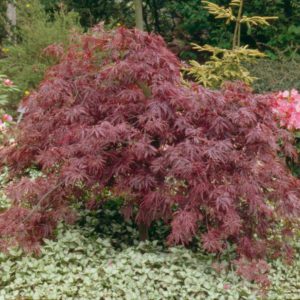
– Foliage: Deeply dissected, lacy, thread-like leaves; deep red-purple on emergence, holding colour through summer, turning fiery red in autumn
– Habit: Weeping, dome-forming — one of the most elegant habits in the garden
– Aspect: Dappled shade to partial shade; shelter from strong winds and harsh midday sun essential
– Soil: Moist, well-drained, neutral to slightly acidic; ericaceous compost for containers
– Hardiness: Hardy; benefits from a sheltered position, particularly when young
– Awards: RHS Award of Garden Merit (AGM)
– Maintenance: Low
Description
There are trees that are beautiful, and then there is Acer palmatum ‘Crimson Queen’ — which is something closer to a year-round work of art. A weeping Japanese Maple of the finest order, it forms a broad, graceful dome of deeply dissected, lacy foliage that changes its mood entirely with every season and never once loses its elegance. The foliage emerges in spring in a deep, rich red-purple — fresh and vivid against the greens of early season — and holds that colour with unusual tenacity through the summer months, when many dissectum varieties soften or fade. Then in autumn it transforms entirely: the red-purple deepens and ignites into a fiery, luminous red that stops people in their tracks, in any garden, every single year.
Slow-growing and compact at 2.5–3m, it earns a permanent, considered place in the garden — never rushing, never overwhelming, always contributing something exceptional to the scene around it.
Caragh Garden Notebook
Planting:
Plant in spring or early autumn into moist, well-drained, neutral to slightly acidic soil enriched with plenty of organic matter. The position matters enormously with this plant — choose somewhere sheltered from cold, drying winds, which will scorch and tatter the delicate lacy foliage, and from harsh, direct midday sun, which can burn the fine leaf margins in a dry summer. Dappled shade beneath deciduous trees is ideal; an east or west-facing position with morning or afternoon sun and shelter from the south-west winds is equally good. In a container, use a quality ericaceous compost with good drainage and choose a pot with generous proportions to support a plant of this scale and longevity. Water in thoroughly after planting and mulch well around the base — keeping the mulch clear of the stem itself to prevent rot.
Watering:
Water generously and consistently through the first two growing seasons while the root system establishes. Japanese Maples establish more slowly than many trees and need reliable moisture during this period — drought stress in the first years will set the plant back significantly. Once established in the ground, ‘Crimson Queen’ is reasonably tolerant, but performs best with consistent moisture through the growing season, particularly during dry spells in summer when the fine, dissected foliage is most vulnerable to scorch. In containers, check moisture levels regularly and water thoroughly — pots can dry out quickly in warm or windy weather, and a stressed container maple will show it immediately in the foliage.
Feeding:
Apply a balanced slow-release fertiliser in spring as growth begins, working it gently into the soil or compost surface around the base of the plant. In containers, feed monthly through the growing season with a balanced liquid fertiliser formulated for acid-loving plants. Avoid high-nitrogen feeds, which push soft, lush growth that is more vulnerable to wind and frost damage. A spring mulch of well-rotted leafmould or composted bark around the root zone feeds gently, retains moisture, and helps maintain the slightly acidic soil conditions the plant prefers.
Pruning:
‘Crimson Queen’ requires very little pruning and generally shapes itself beautifully without intervention. The weeping habit is natural and self-forming — resist the temptation to tidy or adjust the overall shape, as this invariably disrupts the natural dome. If any crossing, dead, or damaged branches need removing, do so in late autumn or very early spring while the tree is fully dormant and the branch structure is clearly visible. Avoid pruning in spring when the sap is rising — Japanese Maples bleed sap heavily at this time and heavy pruning can weaken the tree.
Frost & Shelter:
Young plants and newly emerged spring foliage are vulnerable to late spring frosts, which can damage or kill the fresh growth and set the tree back for the season. In frost-prone gardens, a temporary cover of horticultural fleece during a predicted late frost in April or May will protect the new leaves at their most vulnerable stage. Once the foliage has hardened off through spring, the tree is considerably more resilient. A position with natural overhead protection from nearby trees provides useful frost filtering without compromising light levels.
Pests & Problems:
Generally healthy and trouble-free. Aphids occasionally appear on new growth in spring and can usually be managed with a strong jet of water or left to natural predators. Verticillium wilt can affect Japanese Maples — if sections of the tree die back unexpectedly, remove affected branches well below the point of damage and sterilise tools between cuts. The most common cause of poor performance is position — wind scorch and sun scorch both cause leaf margin browning that can be mistaken for disease but are entirely preventable with the right placement. Avoid waterlogged soils, which will cause root stress in any Japanese Maple.
Design Notes:
The weeping dome of ‘Crimson Queen’ is one of the most distinctive and immediately recognisable forms in garden design — and one of the most effective focal points available for a sheltered border or specimen position. The deep red-purple foliage through summer provides months of sustained colour that few other plants offer at this scale, and the autumn fire is reliably spectacular. Use it as a single specimen in a prominent position where the full dome can be appreciated — beside a pathway, at the corner of a terrace, or reflected in still water for a particularly beautiful effect. It combines naturally with plants that complement rather than compete: blue hostas, silver-leaved woodland perennials, and ornamental grasses all work well beneath and around it. In a Japanese or contemplative garden scheme it is entirely at home; in a more naturalistic woodland planting it brings a refined, jewel-like quality that elevates everything nearby. Plant it where it will be seen from the house — the spring emergence, the steady summer colour, and the autumn blaze are moments worth having a good view of.
Related products
-
Acer palmatum Inaba Shidare / Japanese Maple
Price range: €230.00 through €3,150.00 Select options This product has multiple variants. The options may be chosen on the product page -

Acer shirasawanum Jordan / Jordan full moon maple
€195.00 Select options This product has multiple variants. The options may be chosen on the product page -

Acer palmatum / Japanese Maple
Price range: €250.00 through €750.00 Select options This product has multiple variants. The options may be chosen on the product page -

Acer palmatum Japanese Sunrise
€275.00 Select options This product has multiple variants. The options may be chosen on the product page