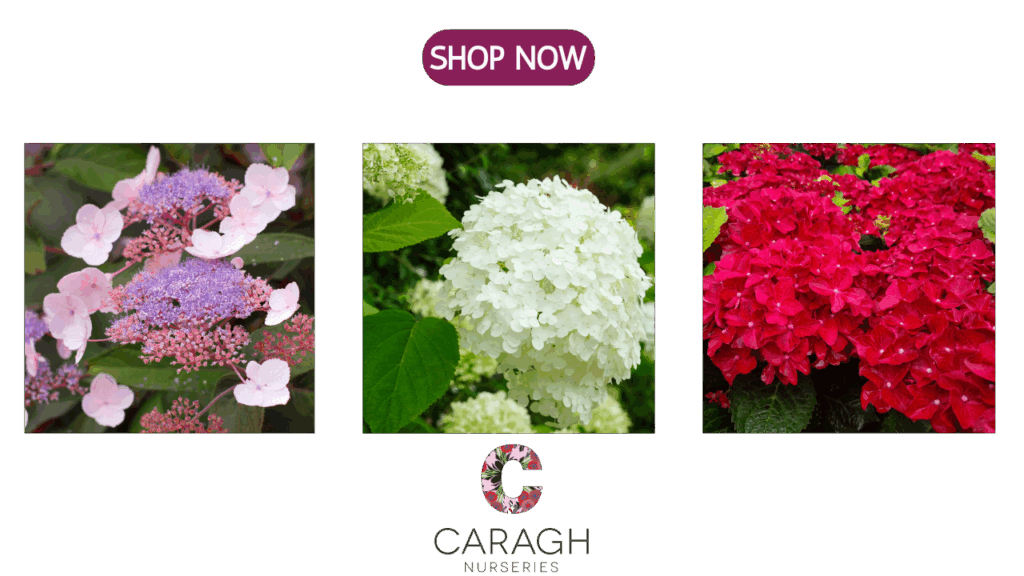
There comes a point each summer when the hydrangeas begin to take over at Caragh. Their flowers seem to appear almost overnight, filling the nursery with great clouds of blue, pink, white, lime green and deep raspberry red.
I have always had a soft spot for them. Perhaps it comes from childhood memories of my mother’s garden, where large mophead hydrangeas flowered generously and a few blooms inevitably found their way indoors. Even now, there is something wonderfully nostalgic about them. However, today’s hydrangeas offer far more choice than the traditional varieties many of us remember.
Some are compact enough for a pot beside the front door. Others make magnificent flowering shrubs for a large border. There are panicle hydrangeas that enjoy sunshine, lacecaps with beautiful foliage and varieties whose flowers change colour as summer moves towards autumn.
Why Hydrangeas Suit Irish Gardens So Well
Hydrangeas enjoy moisture-retentive soil and generally dislike becoming completely dry. That makes them particularly well suited to our Irish growing conditions.
However, they do not want to sit in waterlogged ground. The ideal soil holds moisture while still allowing excess water to drain away. Adding organic matter when planting will improve both light, free-draining ground and heavier soils.
Most mophead and lacecap hydrangeas enjoy dappled light or partial shade. A position with morning sunshine and some protection during the hottest part of the afternoon is often ideal. Panicle hydrangeas, including ‘Limelight’ and ‘Fraise Melba’, will usually accept a sunnier position as long as their roots remain moist.
Before choosing a colour, take a good look at the place where your hydrangea will grow. Consider the amount of light, the available space and how easily you can keep the soil watered. Once you have done that, the enjoyable part begins.
So, which are the best hydrangeas for Irish gardens? These are eight of the varieties currently catching our eye.
Eight Hydrangeas for Irish Gardens
1. Hydrangea macrophylla ‘Marine’
‘Marine’ is the sort of hydrangea that immediately brings a traditional summer garden to mind. It has large, rounded mophead flowers that can range from pink and lilac to beautiful shades of blue.
It is a compact and generous-flowering variety, making it a good choice for smaller borders and substantial containers. Plant it in partial shade with moist, well-drained soil. The flowers are also lovely for cutting and drying.
As with many Hydrangea macrophylla varieties, its eventual flower colour can be influenced by the soil. Acidic conditions tend to encourage bluer flowers, while neutral or alkaline conditions produce pinker shades.

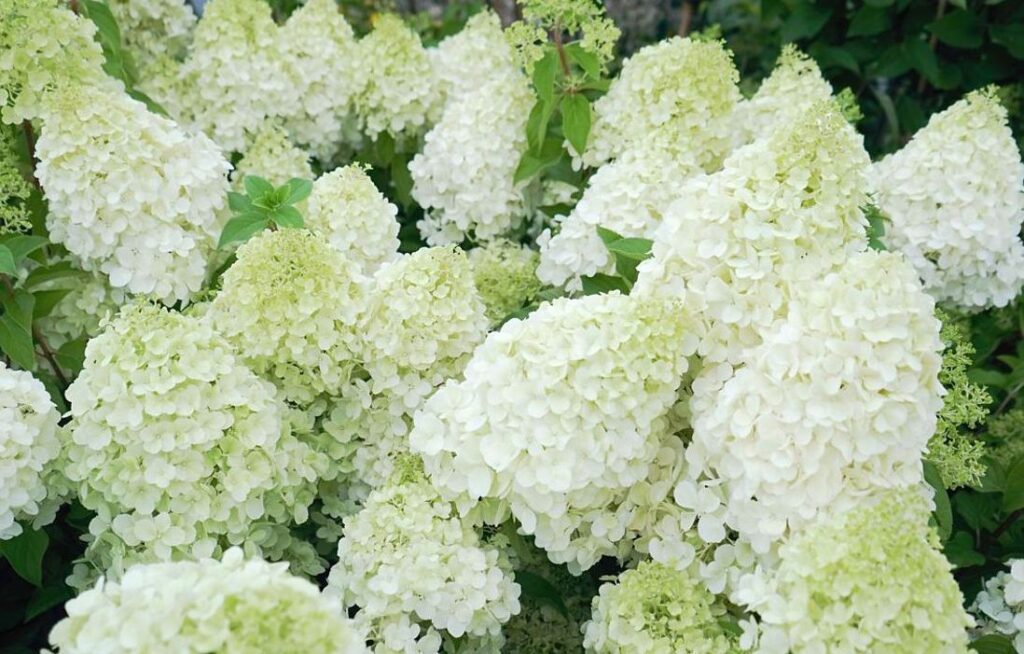
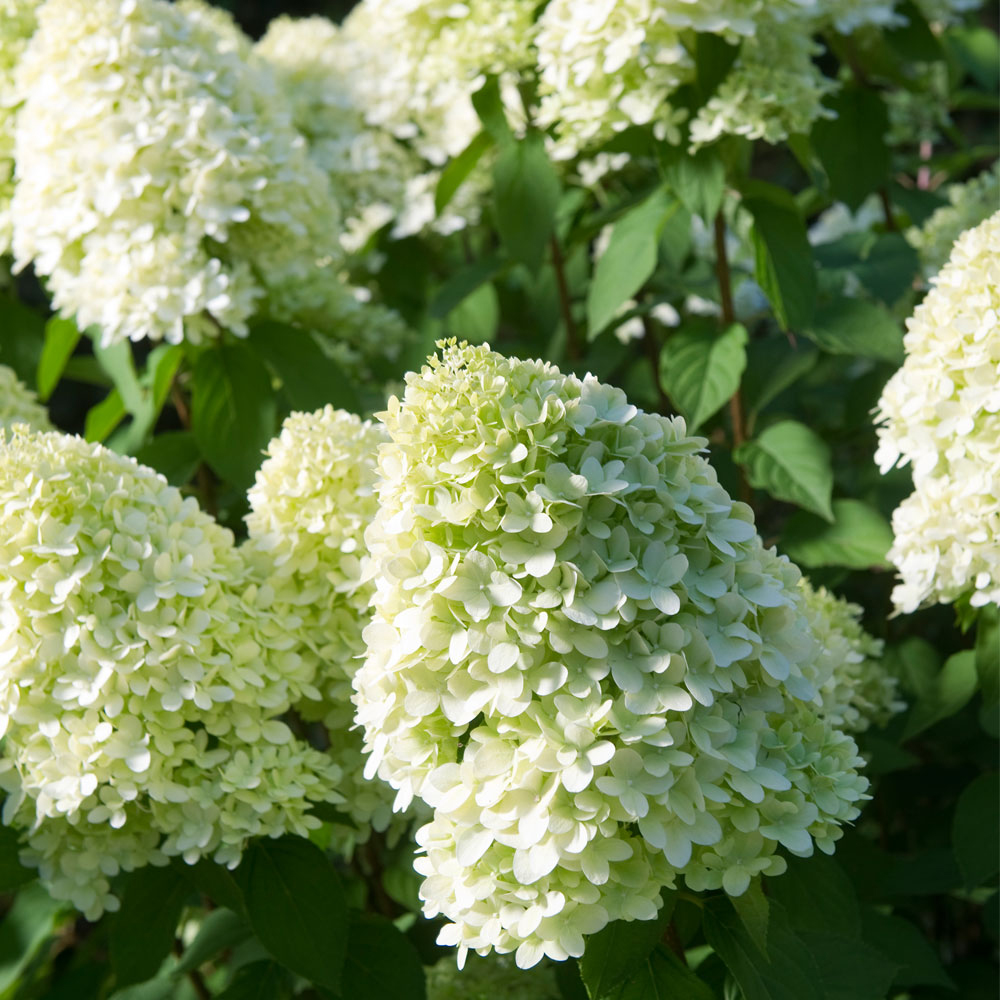
2. Hydrangea paniculata ‘Limelight’
If you prefer something fresher and slightly more contemporary, ‘Limelight’ is difficult to beat.
Its large, cone-shaped flowerheads begin in a cool creamy green. As the season develops, they soften towards cream and may take on warm pink tones in autumn. The flowers look particularly good against dark green foliage or planted among ornamental grasses and late-flowering perennials.
‘Limelight’ is a hardy, fast-growing shrub that enjoys sun or light shade. Unlike the mophead varieties, it flowers on new season’s growth. Therefore, it can be pruned in late winter or early spring.
3. Hydrangea macrophylla ‘Ankong Pink’
‘Ankong Pink’ gives you the full, generous pink flowerheads associated with a classic cottage garden.
It has a naturally compact shape and works beautifully near a terrace, along a path or as part of a mixed border. It can also be grown in a large pot, provided you water it consistently throughout the growing season.
The rich pink flowers continue from summer into autumn. Pair them with soft purple salvias, white perennials or silver foliage for an easy and romantic planting combination.

4. Hydrangea arborescens Strong Annabelle
There is something wonderfully calm about a white hydrangea, and Strong Annabelle is one of the most impressive.
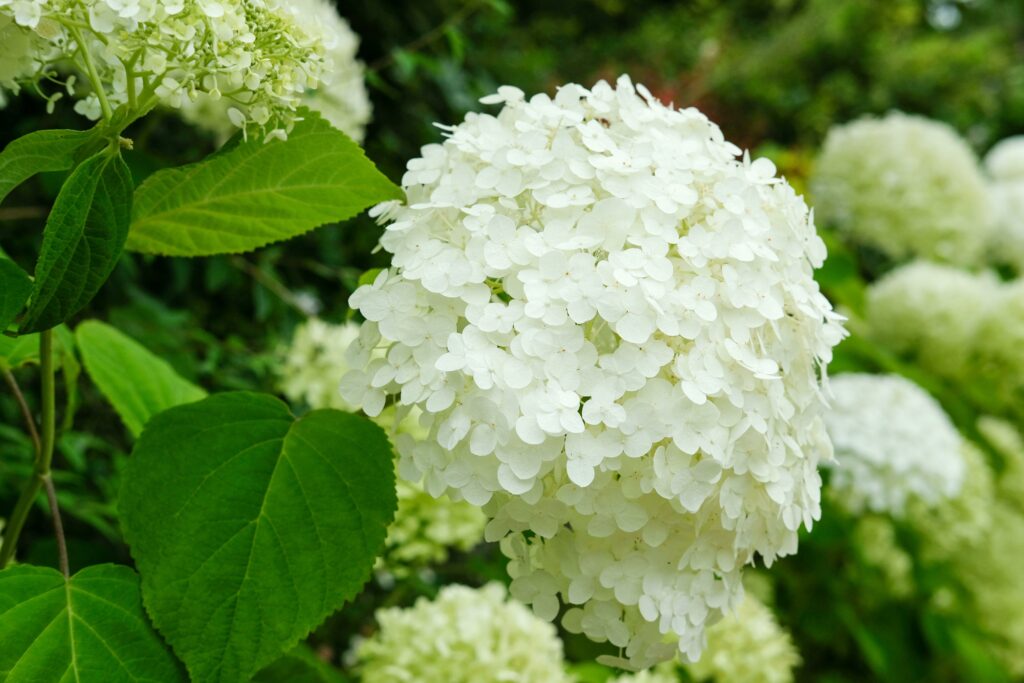
It produces enormous rounded flowerheads, held above fresh green foliage on stronger stems than traditional Annabelle selections. This helps the flowers remain upright after summer rain.
Strong Annabelle usually reaches around 1.5 metres and looks magnificent planted in a group. It suits woodland-style planting, lightly shaded borders and areas where you want a generous sweep of white.
Its colour is not affected by soil pH. The white flowers gradually age to soft green and parchment shades, giving the plant a second, quieter season of interest.
5. Hydrangea macrophylla ‘Firewings’
For gardeners who enjoy confident colour, ‘Firewings’ brings something quite different.
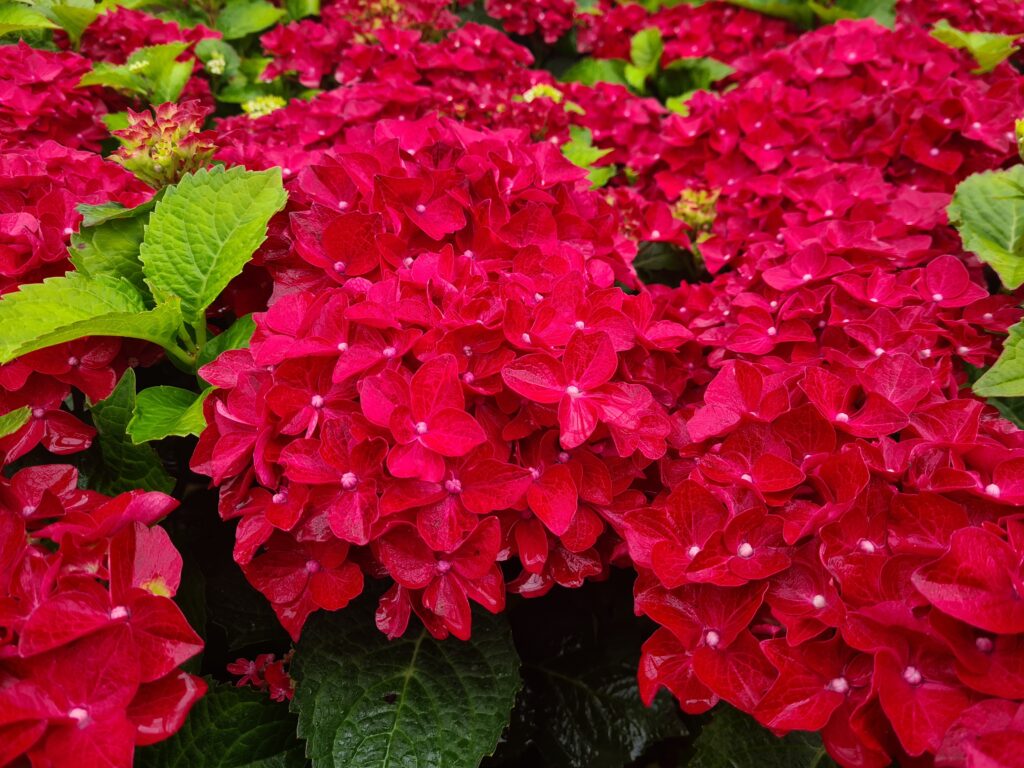
This compact, repeat-flowering hydrangea produces large heads of deep red flowers from summer into autumn. It reaches approximately 1.2 metres in height and spread, so it is suitable for smaller gardens and containers.
Its strong colour works particularly well against green foliage or a simple backdrop. I would allow it to be the star rather than surrounding it with too many competing colours.
6. Hydrangea aspera ‘Hot Chocolate’
‘Hot Chocolate’ proves that hydrangeas can be chosen for their foliage as well as their flowers.
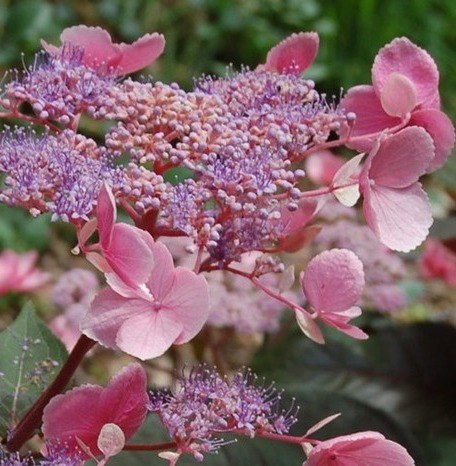
The young leaves appear in rich chocolate-purple tones before maturing to green. Later, they develop warm golden and orange autumn colour. The lacecap-style flowers combine violet-blue centres with soft pink outer florets.
It prefers moist, well-drained soil and a sheltered position in partial shade. It can grow larger than the compact mophead varieties, so give it room to develop. Planted in the right position, it becomes a real feature shrub.
7. Hydrangea paniculata ‘Fraise Melba’
If you want a hydrangea that really puts on a show, Hydrangea ‘Fraise Melba’ is the one
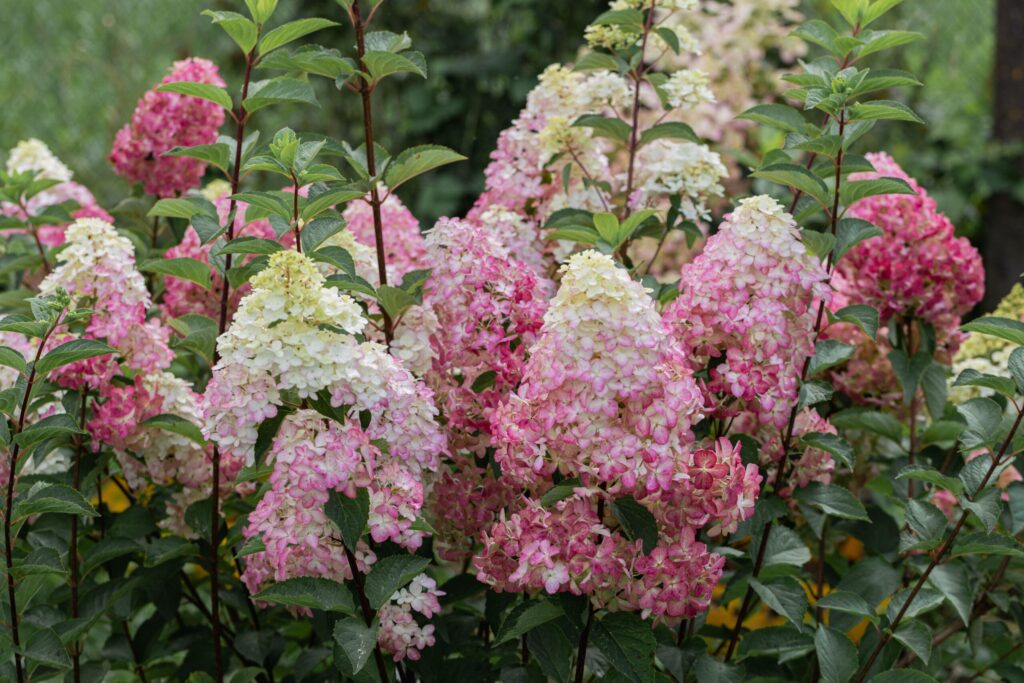
It starts the season with large, elegant cone-shaped blooms in creamy white, then as summer deepens the flowers flush through rose into rich strawberry-pink and raspberry tones, often with a beautiful two-tone effect that looks like it’s been painted on
It is hardy, easy to grow and generally reaches between 1 and 1.5 metres. Its changing flowers make it especially useful in a border designed to carry colour from late summer into autumn.
8. Hydrangea paniculata ‘Diamant Rouge’
‘Diamant Rouge’ is another panicle hydrangea with magnificent seasonal colour.
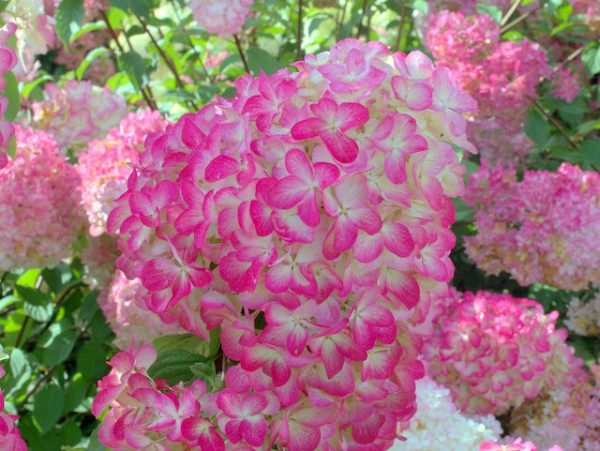
Its substantial flowerheads open white before developing pink tones and, eventually, a deep raspberry red. Strong stems support the large blooms and help the plant maintain an upright shape.
It creates a striking focal point in a sunny or lightly shaded border. Pruning it back in early spring encourages fresh growth and a generous display of flowers later in the year.
Does Soil Change a Hydrangea’s Colour?
This is one of the questions we hear most frequently at the nursery.
The answer is yes, but only for certain hydrangeas. The colour of some blue and pink Hydrangea macrophylla varieties changes according to soil conditions and the availability of aluminium.
Acidic soil tends to encourage blue flowers. Neutral or alkaline soil usually produces mauve or pink flowers. If you want to maintain a blue hydrangea but your garden soil is unsuitable, growing it in a container with ericaceous compost can make the conditions easier to control.
White varieties and panicle hydrangeas do not change from white to blue because of soil pH. Their natural colour progression is part of the variety.
Choosing the Right Hydrangea for Your Garden
If you love classic blue and pink flowers, begin with ‘Marine’ or ‘Ankong Pink’. For pure white flowerheads, choose Strong Annabelle. If you have a sunnier border and want flowers that change as the season progresses, look at ‘Limelight’, ‘Vanille Fraise’ or ‘Diamant Rouge’.
For bold red colour in a smaller space, ‘Firewings’ is a wonderful option. Meanwhile, ‘Hot Chocolate’ is the one to choose when foliage and autumn interest matter just as much as summer flowers.
Of course, choosing from photographs is never quite the same as standing in front of a hydrangea in full bloom. The scale, colour and abundance of the flowers are much easier to appreciate in person.
Visit us at Caragh Nurseries in Caragh, near Naas, Co. Kildare, and take a wander through our hydrangea collection. Our team can help you choose a variety for your particular garden, position and soil.
You can also browse our current hydrangea collection online. Availability changes throughout the season, so if a particular variety has caught your eye, please contact us and we will be happy to help.
After all that, the only difficult question is whether there is room in the garden for just one.