

Acer palm. ‘Beni Hagoromo’
€225.00
Frequently Bought Together
Description
Quick Facts
– Botanical Name:Acer palmatum ‘Beni Hagoromo’
– Common Name: Beni Hagoromo Japanese Maple
– Name Meaning: ‘Beni Hagoromo’ translates from Japanese as ‘Crimson Feathered Robe’ — a name that describes the plant precisely
– Plant Type: Deciduous tree / large shrub
– Mature Height: 2.5–3m
– Mature Spread: 1–1.5m — notably compact and upright
– Growth Rate: Slow
– Foliage: Finely dissected, feathery leaves with a deeply distinctive lobed shape; crimson red in spring, deepening to rich green-purple through summer, transitioning to fiery red in autumn
– Habit: Neat, upright — more columnar and contained than most Japanese Maples
– Aspect: Partial sun to dappled shade; leaf colour is most vibrant and distinctive in good light
– Soil: Moist, well-drained, neutral to slightly acidic; ericaceous compost for containers
– Hardiness: Hardy; benefits from shelter from cold winds and late frosts
– Maintenance: Low
Description
The name tells you everything and nothing — Beni Hagoromo, Crimson Feathered Robe — and yet seeing the plant for the first time, you understand immediately why it was given it. The leaves are deeply and intricately dissected into fine, overlapping lobes that give the whole tree the appearance of being draped in feathers: layered, intricate, and completely unlike any other Japanese Maple. It is the kind of detail that makes people reach out a hand to touch it before they can stop themselves.
The colour journey through the seasons is one of its great pleasures. Crimson red on emergence in spring — vivid and unmistakable — before shifting gradually through summer into a deep, brooding green with purple undertones. The depth and richness of that summer colouring is directly responsive to light: in a position with good sunlight, the red tones remain more present and the purple more vibrant; in too much shade, the foliage resolves to a quieter green-purple that is beautiful in its own right but tells only part of the story. Then in autumn, the whole palette reanimates into fiery red before the leaves drop for winter.
Unlike the broad, weeping dome of ‘Crimson Queen’, ‘Beni Hagoromo’ grows with a neat, upright habit — compact in spread, considered in form, and perfectly proportioned for smaller gardens and containers where space matters.
Caragh Garden Notebook
Planting:
Plant in spring or early autumn into moist, well-drained, neutral to slightly acidic soil enriched with plenty of leafmould or well-rotted organic matter. Position with real thought — the light level at the chosen site will directly determine the quality and vibrancy of the leaf colour throughout the growing season. A spot with good morning or afternoon sunlight, sheltered from cold drying winds and harsh midday sun, will give the most striking colour display. Full shade will produce a predominantly green-purple leaf that loses the crimson quality the variety is known for. In a container, use a quality ericaceous compost with good drainage — the compact, upright habit makes ‘Beni Hagoromo’ one of the finest Japanese Maples for pot culture. Mulch well around the base, keeping the mulch clear of the stem.
Watering:
Water generously and consistently through the first two growing seasons while the root system develops — Japanese Maples are slow to establish and need reliable moisture during this period. Once established in the ground, the plant manages reasonably well with natural rainfall, but consistent moisture through summer produces the richest, most sustained leaf colour and prevents the margin scorch that affects the delicate foliage in dry conditions. In containers, water thoroughly and regularly through the growing season — check daily in warm weather and never allow the compost to dry out completely, as a stressed container maple shows the effects in the foliage immediately.
Feeding:
Apply a balanced slow-release fertiliser in spring as growth begins, working it gently into the soil surface around the base of the plant. In containers, feed monthly through the growing season with a balanced liquid fertiliser suitable for acid-loving plants. Avoid high-nitrogen feeds, which encourage soft, lush growth vulnerable to wind and frost damage. An annual spring mulch of leafmould or composted bark around the root zone will feed gently, retain moisture, and help maintain the slightly acidic conditions the plant prefers.
Pruning:
‘Beni Hagoromo’ requires very little pruning — the neat, upright habit is natural and self-forming and is best left to develop without intervention. If any dead, damaged, or crossing branches need removing, do so in late autumn or very early winter while the tree is fully dormant and the branch structure is clearly visible. Avoid pruning in spring when the sap is rising, as Japanese Maples bleed heavily at this time and excessive pruning in the growing season can weaken the tree significantly. The natural form is the finest thing about this variety — trust it.
Frost & Shelter:
Like all Japanese Maples, ‘Beni Hagoromo’ is vulnerable to late spring frosts that can damage or kill the newly emerged foliage and, in a bad year, set the tree back for the entire season. A position with natural overhead protection from nearby trees or a warm wall will provide useful frost filtering at the most vulnerable stage. In particularly frost-prone gardens, a temporary cover of horticultural fleece during a predicted late frost in April or May will protect the fresh spring growth when it is at its most beautiful and most delicate. Once the foliage has hardened through late spring, the tree becomes considerably more resilient.
Pests & Problems:
Generally healthy and trouble-free. Aphids can occasionally colonise new spring growth — usually manageable without intervention as natural predators establish. The most common problems are positional rather than pest-related: wind scorch produces brown, tattered leaf margins; sun scorch produces bleached or brown patches on the finer leaf tips in very exposed, hot conditions; too much shade produces a flat, undistinguished green-purple that fails to show the variety’s true colour. All three are entirely preventable with careful siting at the outset. Avoid waterlogged soils, which cause root stress in any Japanese Maple.
Design Notes:
The upright, columnar habit of ‘Beni Hagoromo’ makes it one of the most versatile Japanese Maples for garden design — it provides the height, the seasonal drama, and the extraordinary foliage detail of the family without requiring the width that the weeping varieties demand. In a smaller garden it is genuinely invaluable: a vertical accent of sustained seasonal colour that never sprawls beyond its allotted space. Use it as a focal specimen in a sheltered border where the feathered foliage can be seen at close range and the seasonal colour change appreciated from the house through spring and autumn; plant it in a large container on a sheltered terrace for a year-round presence of quality and detail; or use it alongside ‘Crimson Queen’ for a Japanese Maple pairing of contrasting habits — the weeping dome and the upright column, both carrying the same deep red-purple through summer and the same fiery red in autumn, in completely different forms. Companion plants with simple, bold foliage — blue hostas, large-leaved bergenia, architectural ferns — allow the intricate feathered texture of the maple to read most clearly and provide the contrast that shows it at its best.
Additional information
| Pot Size |
|---|
Related products
-

Acer palmatum Atropurpureum
Price range: €120.00 through €140.00 Select options This product has multiple variants. The options may be chosen on the product page -
Acer palmatum Inaba Shidare / Japanese Maple
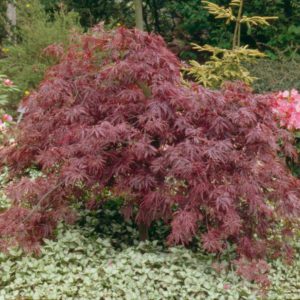
Price range: €230.00 through €3,150.00 Select options This product has multiple variants. The options may be chosen on the product page -
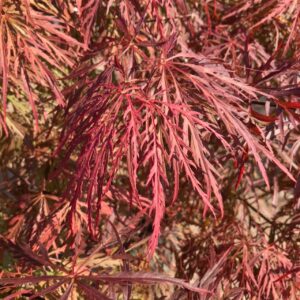
Acer palm. ‘Crimson Queen’
€225.00 Select options This product has multiple variants. The options may be chosen on the product page -

Acer palmatum ‘Ryusen’
€225.00 Select options This product has multiple variants. The options may be chosen on the product page