

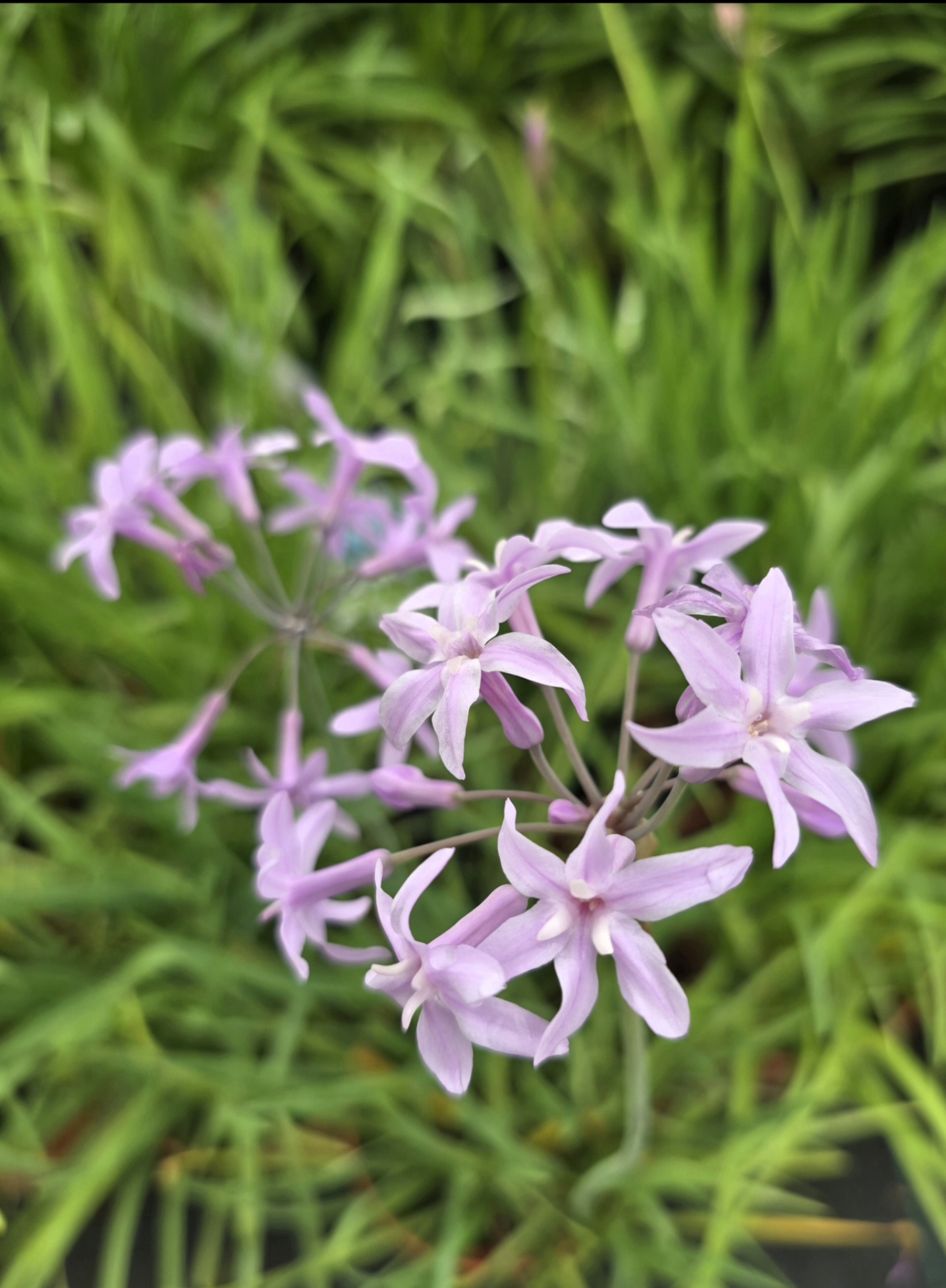
Tulbaghia violacea
€10.50
Frequently Bought Together


Description
Quick Facts
- Botanical Name: Tulbaghia violacea
- Common Name: Society Garlic
- Plant Type: Herbaceous perennial (often evergreen in mild areas)
- Habit: Clump-forming, grass-like leaves with airy flower stems
- Height (approx.): 30–60cm in flower
- Spread (approx.): 30–45cm
- Flowering: Long season — typically summer into early autumn
- Flower Colour: Soft lilac to violet, starry blooms
- Fragrance: Flowers are lightly sweet; foliage has a garlic scent when crushed
- Position: Full sun (best flowering)
- Soil: Free-draining; drought-tolerant once established
- Hardiness: Hardy in mild, sheltered Irish/UK gardens; protect from hard frost and winter wet
- Best For: Gravel gardens, pots, Mediterranean borders, pollinator planting, edging, drought-tolerant schemes
Description
Tulbaghia violacea is one of those plants that quietly earns its place — neat, long-flowering, and effortlessly useful.
From a clump of slender, grey-green leaves, it sends up stems topped with lilac, star-shaped flowers that keep coming for months. The look is light and airy, perfect for weaving through gravel planting or softening the edge of a sunny border.
And then there’s its secret superpower: the foliage has a gentle garlic scent when brushed, which many gardeners love for its reputation as a natural deterrent to pests (while still being beautifully ornamental).
Caragh Garden Notebook
Planting & position
Full sun gives the best flowering and the strongest, tidiest growth. In Ireland and the UK, it’s happiest in a warm, sheltered spot — a courtyard, raised bed, or beside a sunny wall is ideal.
Full sun gives the best flowering and the strongest, tidiest growth. In Ireland and the UK, it’s happiest in a warm, sheltered spot — a courtyard, raised bed, or beside a sunny wall is ideal.
Soil & drainage
Drainage is key.
Drainage is key.
- Plant into free-draining soil and improve heavy ground with grit.
- In pots, use a gritty compost mix and ensure excellent drainage holes.
Winter wet is more of a problem than cold.
Watering
- Water regularly while establishing.
- Once settled, it’s drought-tolerant and prefers to dry slightly between waterings.
- Container plants will need watering during warm spells.
Feeding
A light feed in spring (or a top-dress of compost) is plenty. Too much feeding can encourage soft growth.
A light feed in spring (or a top-dress of compost) is plenty. Too much feeding can encourage soft growth.
Deadheading & tidying
- Snip off spent flower stems to keep it looking fresh and to encourage more blooms.
- Tidy older leaves as needed.
Winter care
In colder areas, it may die back and return in spring. In very wet/cold spots, it’s often best grown in a pot so it can be moved to shelter in winter.
In colder areas, it may die back and return in spring. In very wet/cold spots, it’s often best grown in a pot so it can be moved to shelter in winter.
Design notes
- Beautiful with lavender, rosemary, salvias, agapanthus, grasses, and olive trees
- Perfect for gravel gardens and sunny, drought-tolerant borders
- Lovely repeated in drifts for a soft, long-season haze of lilac
Related products
-
Prunus Fukubana
Read more -
Prunus cerasifera Nigra / Purple Plum
€75.00 Select options This product has multiple variants. The options may be chosen on the product page -

Spiraea ‘Firelight’
€9.50 Select options This product has multiple variants. The options may be chosen on the product page -

Geranium maculatum Espresso
€8.50 Select options This product has multiple variants. The options may be chosen on the product page