

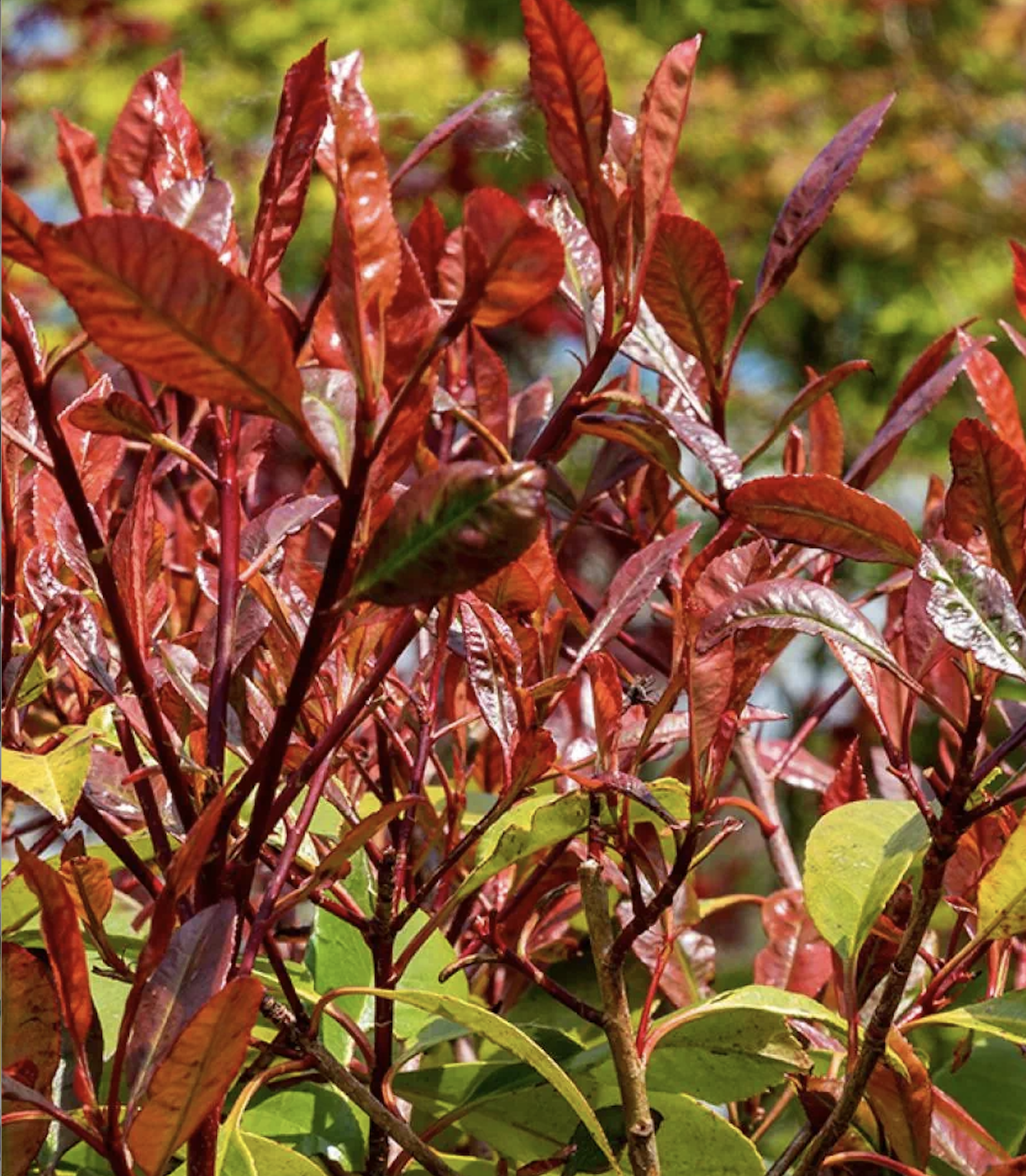
Photinia ‘Red Select’
€65.00
Description
Quick Facts
– Botanical Name: Photinia × fraseri ‘Red Select’
– Common Name: Red Select Photinia / Red Robin Photinia
– Plant Type: Evergreen shrub
– Mature Height: 2–3m
– Mature Spread: 1.5–2.5m
– Growth Rate: Moderate
– Foliage Colour: Brilliant, glossy bright red new growth in spring, maturing through coppery-red to deep glossy green; a further flush of red on new growth through the season
– Habit: Upright, bushy; responds excellently to clipping for hedging and topiary
– Flowers: Clusters of small creamy-white flowers in late spring (often removed to encourage more new foliage)
– Aspect: Full sun to partial shade; new growth colours more vividly in a sunny position
– Soil: Moist, well-drained; tolerant of most soil types once established
– Hardiness: Hardy; benefits from shelter in exposed or cold positions
– Maintenance: Low — respond well to regular light clipping
Description
Photinia ‘Red Select’ delivers one of the most striking and dependable colour effects the evergreen garden offers — a vivid flush of brilliant glossy red new growth in spring that makes the whole plant look as though it is on fire, before maturing through coppery tones to a rich, deep glossy green. And it does not stop at spring: throughout the growing season, each fresh flush of new growth repeats that red moment, giving the plant repeated displays of colour rather than a single annual one.
An improved selection of the ever-popular ‘Red Robin’, ‘Red Select’ is bred for a more compact, self-branching habit and an excellent, sustained show of red new growth. It takes clipping extremely well, which makes it one of the most versatile evergreen shrubs available — as a free-standing specimen, a formal globe, a hedge, or a screening plant — and it brings both structure and a genuinely spectacular seasonal colour show to the garden at a very reasonable level of maintenance.
Caragh Garden Notebook
Planting:
Plant in autumn or early spring into moist, well-drained soil. ‘Red Select’ is tolerant of most reasonable garden soils once established but performs best in moderately fertile, well-drained conditions. A position in full sun produces the most vivid, sustained red new growth; partial shade is tolerated but the red colouring will be less intense and the growth more open. Choose a slightly sheltered position if possible, particularly in colder or exposed gardens, as the new growth can be damaged by frost and cold, drying winds. Water in thoroughly after planting and mulch around the base to retain moisture through the first season.
Watering:
Water consistently through the first two growing seasons while the root system establishes. Once settled, ‘Red Select’ is reasonably self-sufficient and tolerant of drier conditions, though it performs best with reliable moisture through the growing season. During prolonged dry spells in summer, a thorough watering will maintain the freshness of the foliage and the quality of new growth. Avoid waterlogged conditions — good drainage is as important as consistent moisture.
Feeding:
An annual feed in spring with a balanced slow-release fertiliser will support strong, healthy growth and encourage the abundant new growth that carries the red colour. A generous mulch of well-rotted compost or manure applied around the base in late winter or early spring feeds gently, retains moisture, and improves the soil over time — particularly valuable in poorer or lighter soils. In containers, feed monthly through the growing season with a balanced liquid fertiliser.
Pruning:
This is where ‘Red Select’ rewards the gardener most directly, because the red colour is carried entirely by new growth — the more you prune and the more regularly you clip, the more red you get. For a hedge or formal shape, clip 2 to 3 times through the growing season from spring to late summer, after each flush of red has matured, to encourage the next vibrant burst of new growth. For a free-standing shrub, prune lightly in spring and again if desired in summer to shape and stimulate fresh colour. Avoid heavy pruning very late in the season, as the soft new growth it encourages will be vulnerable to winter frost.
Renovation & Establishment:
Young plants establish most reliably with consistent moisture and a sheltered start. If established plants have become leggy, thin, or bare at the base, a harder renovation prune in spring will encourage new growth from lower down — ‘Red Select’ tolerates renovation pruning well and will respond with dense, healthy regrowth. This is best carried out in early spring before the main flush of growth begins.
Pests & Problems:
Generally healthy and trouble-free. The most common concern in colder gardens is frost damage to the soft new growth in late spring — this is usually cosmetic and the plant recovers with the next flush, though heavy or repeated frosts can set back the display for the season. Fireblight can occasionally affect Photinia in some regions; if sections of the plant suddenly blacken and die back, remove affected growth well into healthy wood and sterilise tools between cuts. Scale insects and leaf spot can occasionally appear — monitor regularly and treat as needed. Positioning in a sheltered, reasonably sunny position is the single most reliable preventative measure for most problems.
Design Notes:
The repeated flushes of brilliant red new growth make ‘Red Select’ one of the most effective and reliable colour providers among evergreen shrubs — a plant that brings genuine drama to the garden through spring and summer while holding solid evergreen structure through winter. Use it as a hedge or formal clipped shape for a fast effect of colour and structure that responds beautifully to regular clipping; plant a specimen where the red flush can be seen against lighter backgrounds — a pale wall, a lawn, or the deeper greens of conifers and established evergreen planting — where the red glows most vividly; or use it in groups of three or more for a more substantial seasonal display. Combined with low evergreen structure, purple or blue foliage, and grasses, it works as well in a contemporary scheme as in a more traditional planting. In a mixed border it holds the structure through winter and delivers its dramatic colour moments through the growing season — genuine year-round value in a single plant.
Additional information
| Pot Size |
|---|
Related products
-
Cotoneaster ‘Cornubia’
Price range: €220.00 through €320.00 Select options This product has multiple variants. The options may be chosen on the product page -
Acer Crimson King / Red Norway Maple
Price range: €75.00 through €950.00 Select options This product has multiple variants. The options may be chosen on the product page -
Crataegus Pauls Scarlet / Red Hawthorn
Price range: €45.00 through €240.00 Select options This product has multiple variants. The options may be chosen on the product page -
Hebe ‘Red Edge’
€8.50 Select options This product has multiple variants. The options may be chosen on the product page