

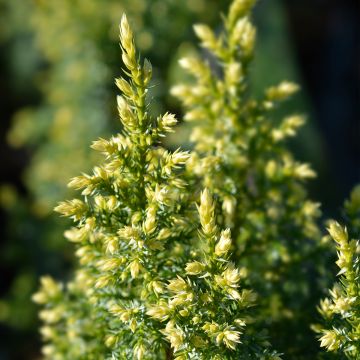
Juniperus communis ‘Gold Cone’
€25.00
Description
Quick Facts
- Botanical name: Juniperus communis ‘Gold Cone’
- Common name: Golden common juniper
- Type: Evergreen coniferous shrub / small tree
- Mature height and spread: Around 2–3m tall and 50–70cm wide after 10–15 years. Slow to moderate growth.
- Flowering period and colour: Insignificant. Conifers carry small cones, not showy flowers.
- Foliage: Narrow, prickly needle foliage in golden-yellow, held on a narrow, upright, conical form. Colour is strongest in spring and summer and may deepen slightly in winter.
- Hardiness: Fully hardy in Ireland and the UK (RHS H7, to about -20°C or lower).
- Soil: Well-drained soil, including poor, sandy or chalky ground. Dislikes waterlogging.
- Aspect: Full sun for the best golden colour. Foliage turns greener in shade.
- Maintenance: Low.
Description
A neat, narrow golden juniper that holds a tidy upright cone shape year-round with minimal pruning. The bright golden-yellow foliage lights up a border, even on dull days, and keeps its colour through winter. Perfect for small gardens, formal planting in pairs, and large containers by an entrance.
Caragh Garden Notebook
Planting Plant in autumn or spring in full sun and free-draining soil. Dig a hole about twice as wide as the pot, keep the rootball level with the surface, firm in gently and water well. On heavy clay, improve the drainage or plant on a slight mound.
Watering Water regularly through the first season to establish a good root system. Once settled it is fairly drought tolerant, but it benefits from watering in prolonged dry spells. Container plants need watering more often. Avoid waterlogged soil.
Feeding Little feeding is needed in the ground. A slow-release conifer fertiliser in spring suits container plants. Mulch lightly to keep the roots cool and moist.
Seasonal Care and Tidy-Up Spring: Check for any winter damage and feed pots. Summer: Keep container plants watered. Autumn: Brush fallen debris off the foliage and base. Winter: In heavy snow, gently shake the branches to avoid bending or splaying.
Division Not applicable. Pruning is minimal. Trim lightly in spring or late summer only if needed, cutting back to green growth. Junipers don’t reliably regrow from bare, brown wood, so never cut into it. If the stems begin to splay, loosely tie them with soft twine.
Pests and Problems
- Phomopsis tip blight: A fungal disease causing browning and dieback of the young shoot tips, mainly in damp conditions. Remove affected tips, improve airflow, and avoid overhead watering.
- Juniper scale and aphids: Small sap-feeding insects that cause yellowing patches. Check the foliage regularly.
- Winter wet: Poor drainage is a more common cause of loss.
- Handling: The needles are sharp, and the sap can irritate sensitive skin. Wear gloves and long sleeves when planting and pruning.
Design Notes A strong vertical accent for small gardens, formal pairs either side of a doorway or path, or repeated in a row for structure. Its golden colour contrasts well with dark evergreens, purple foliage, heathers and grasses. It also works well in large pots and gravel gardens.
Propagation Nurseries mostly propagate named junipers from cuttings in late summer to autumn, which can be slow and unreliable for the home gardener. Seed won’t reliably produce the same tree.
Additional information
| Pot Size |
|---|
Related products
-
Buddleja Black Knight
€12.50 Select options This product has multiple variants. The options may be chosen on the product page -
Quercus rubra / Red Oak
Price range: €150.00 through €450.00 Select options This product has multiple variants. The options may be chosen on the product page -

Choisya ternata – Mexican Orange Blossom
Price range: €9.50 through €22.00 Select options This product has multiple variants. The options may be chosen on the product page -
Crataegus Pauls Scarlet / Red Hawthorn
Price range: €45.00 through €240.00 Select options This product has multiple variants. The options may be chosen on the product page