
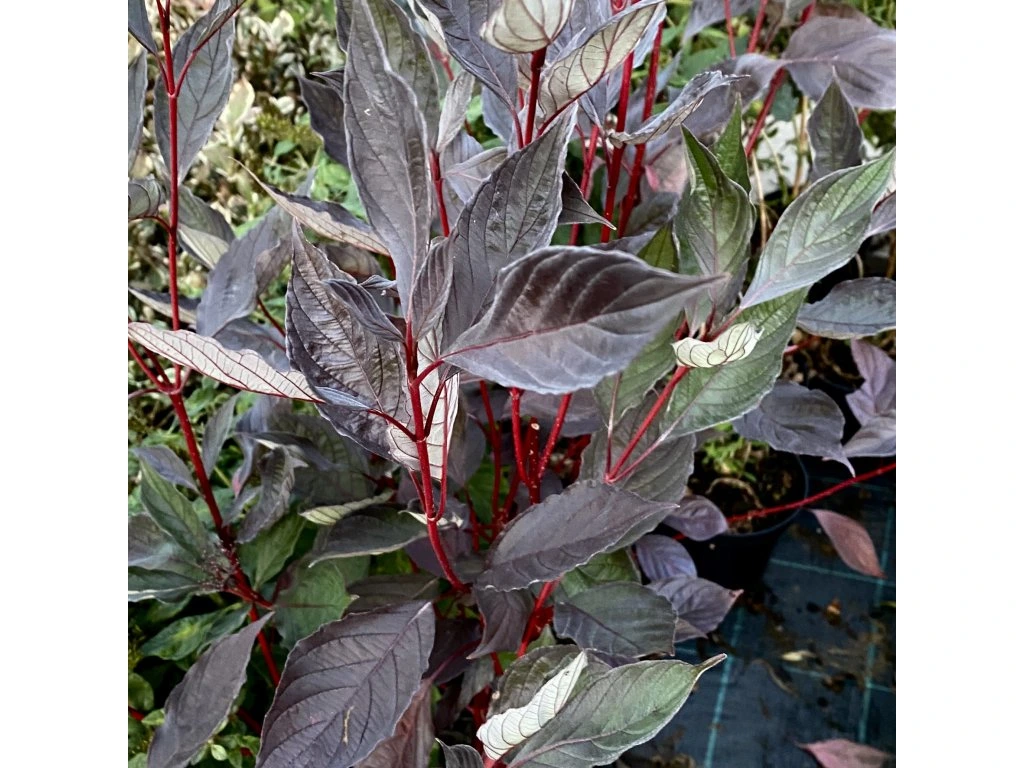
Cornus alba Nightfall
€20.00
Frequently Bought Together

Description
Quick Facts
- Common Name: Nightfall Red-Barked Dogwood, Nightfall Red Twig Dogwood
- Botanical Name: Cornus alba ‘Nightfall’
- Plant Type: Deciduous shrub
- Mature Height: 1.5-2m
- Mature Spread: 1.5-2m
- Flowering Period: May to June
- Flower Colour: Creamy-white
- Foliage: Deep purple-black to dark burgundy deciduous leaves turning rich red-purple in autumn; brilliant red stems in winter
- Hardiness: RHS H7 (very hardy throughout UK and Ireland)
- Soil Requirements: Moist, well-drained soil (tolerates wet conditions)
- Aspect: Full sun to partial shade
- Maintenance: Low to moderate (benefits from annual hard pruning)
Description
Experience the breathtaking beauty of Cornus alba ‘Nightfall’, one of the most spectacular and dramatically coloured deciduous shrubs for gardens, where extraordinary deep purple-black foliage, brilliant red winter stems, and compact vigorous habit combine to create stunning displays of year-round colour and exceptional seasonal interest that bring months of dark dramatic foliage and spectacular winter stem colour with remarkable intensity making this perfect for adding bold foliage contrast, winter drama, and reliable multi-season interest to mixed borders, winter gardens, and waterside plantings where exceptional colour and architectural presence are essential. This exceptional cultivar offers remarkable qualities—extraordinary deep purple-black to dark burgundy foliage creating one of the darkest and most dramatic leaf colours of any dogwood, brilliant coral-red to crimson-red winter stems providing spectacular winter colour for 4-5 months, compact habit reaching only 1.5-2m tall making it ideal for smaller gardens where larger dogwoods would overwhelm, rich red-purple autumn colour providing seasonal finale before leaves fall, and outstanding hardiness and adaptability thriving in wide range of conditions including wet soils throughout UK and Ireland with remarkable vigour, making this one of the most rewarding and versatile choices for adding bold foliage colour, winter stem drama, and year-round interest to gardens.
Throughout the seasons, this captivating shrub displays spectacular multi-season interest—in spring and summer (April-October), the foliage is the primary ornamental feature creating extraordinary displays. The leaves emerge in spring as deep purple-black to nearly black creating dramatic impact. The leaves are oval to elliptical, measuring 5-10cm long and 3-6cm wide with smooth edges and pointed tips creating refined appearance. The leaf colour is deep purple-black to dark burgundy to blackish-purple creating one of the darkest foliage colours available—significantly darker than most purple-leaved plants. The colour is most intense in full sun—in shade, foliage may be more purple-green but still attractive. The dark foliage creates stunning contrast against lighter-coloured plants and provides dramatic backdrop throughout growing season. The foliage density is substantial, creating excellent coverage. In late spring to early summer (May-June), the plant produces small creamy-white flowers arranged in flat-topped clusters (cymes) measuring 3-5cm across. The flowers are not particularly showy against the dark foliage but add subtle interest and attract pollinators. Following flowering, small white to bluish-white berries may develop, though these are not ornamentally significant and are often eaten by birds. In autumn (October-November), the foliage undergoes beautiful transformation—the deep purple-black leaves turn rich red-purple to burgundy-red creating warm displays before falling. As leaves drop in late autumn, the plant’s most spectacular winter feature is revealed—brilliant coral-red to crimson-red to scarlet-red young stems creating extraordinary winter colour. The stem colour is most intense on young growth (1-2 year old stems)—the younger the stem, the more brilliant the colour. The stems are smooth and glossy, creating polished appearance. The winter stem display is spectacular and lasts 4-5 months (November-March), providing essential colour when gardens are dormant. The stems are particularly striking in low winter sun, against snow, or reflected in water. The growth habit is upright, dense, and compact—multiple stems arise from base creating bushy rounded form. Mature plants typically reach 1.5-2m tall and equally wide, remaining more compact than many Cornus alba cultivars. Growth is moderate to vigorous, adding 30-40cm annually. The overall effect is dramatic, colourful, and exceptionally striking—like having deep purple-black foliage creating bold contrast in summer transforming to brilliant red stems creating spectacular winter displays with year-round interest.
Native to Siberia, northern China, and Korea where Cornus alba (red-barked dogwood or Tatarian dogwood) grows wild in moist woodlands and along streams, this species has been cultivated in European gardens since the 18th century for its winter stem colour. The genus name Cornus comes from the Latin ‘cornu’ (horn), referring to the hard wood. The species name ‘alba’ means “white,” referring to the white berries. ‘Nightfall’ is a modern cultivar specifically selected for exceptional deep purple-black foliage creating dramatic contrast (one of the darkest-leaved dogwoods), brilliant coral-red winter stems providing spectacular winter colour, compact habit ideal for smaller gardens, and excellent garden performance. This represents one of the finest selections for combining dark foliage and winter stems—most red-stemmed dogwoods have green foliage, while ‘Nightfall’ offers both features. Hardy to RHS H7, this exceptionally robust shrub thrives throughout UK and Ireland with complete reliability, tolerating cold winters (to -25°C), exposed positions, wet soils, and challenging conditions. Moderate to vigorous growth rate, forming substantial specimens within 3-5 years. Particularly valuable for extraordinary deep purple-black foliage creating bold contrast and dramatic displays, brilliant coral-red winter stems providing 4-5 months of spectacular colour, compact habit ideal for smaller gardens, rich red-purple autumn colour, and outstanding tolerance of wet soils making this excellent for waterside plantings. The combination of dark foliage and red winter stems makes this outstanding for year-round interest.
Create stunning compositions by planting in mixed borders where the deep purple-black foliage creates bold contrast against lighter-coloured plants (silver, lime-green, golden foliage) and the winter stems provide seasonal drama, using in winter gardens combined with other winter-interest plants (coloured-stem dogwoods, evergreens, winter-flowering shrubs, ornamental grasses) creating multi-layered seasonal displays, or positioning near water features, ponds, or streams where the wet-soil tolerance ensures success and winter stems reflect beautifully in water. Exceptional in contemporary gardens where the dark foliage provides dramatic architectural presence, in wildlife gardens where the flowers attract pollinators and berries feed birds, or as informal hedging or screening (plant 1-1.5m apart) where the dense growth creates substantial barriers. Works beautifully combined with contrasting foliage colours—golden foliage plants (Choisya ‘Sundance’, Philadelphus ‘Aureus’, golden grasses) for vibrant contrast, silver foliage plants (Artemisia, Stachys, Elaeagnus) for sophisticated combinations, or lime-green foliage (Alchemilla mollis, Heuchera ‘Lime Marmalade’) for fresh contrast. Also magnificent combined with other coloured-stem dogwoods (Cornus sanguinea ‘Midwinter Fire’ with orange stems, Cornus alba ‘Kesselringii’ with black stems) for varied winter colour, ornamental grasses (Miscanthus, Calamagrostis, Molinia) for textural contrast and winter seedheads, or spring bulbs (snowdrops, crocuses, daffodils) that bloom as stems fade and new foliage emerges. Perfect for adding bold foliage colour, winter stem drama, and year-round interest to mixed borders, winter gardens, and waterside plantings. Excellent for wildlife and winter colour.
Caragh Garden Notebook
Planting: Space plants 1.5-2m apart for individual specimens, or 1-1.5m apart for informal hedging or groupings. Plant bare-root specimens in dormant season (November-March) or container-grown specimens year-round, though autumn (October-November) or spring (March-April) is ideal for best establishment. Choose position in full sun to partial shade—full sun produces most intense deep purple-black foliage colour and most brilliant red winter stems, while partial shade produces more purple-green foliage but still attractive. Thrives in range of exposures and tolerates exposed positions. Particularly suited to moist positions near ponds, streams, or in areas with naturally wet soils. Dig generous planting hole twice width of root ball and same depth. Incorporate organic matter (well-rotted compost, leaf mould) into backfill soil to improve fertility and moisture retention. Plant at same depth as in container or at same depth as previously grown (look for soil mark on bare-root stems). Backfill carefully, firming gently. Water thoroughly after planting. Apply 5-8cm mulch around base, keeping mulch clear of stems (5cm gap). Water regularly during first growing season. Position where the dark foliage and winter stems can be appreciated year-round, particularly where low winter sun can illuminate the brilliant red stems.
Soil Preparation: Prefers moist, well-drained soil for best growth, but remarkably adaptable. Tolerates wide pH range from acidic to alkaline (pH 5.0-8.0)—one of the most adaptable shrubs. Thrives in wide range of soil types including sandy, loamy, clay, and even heavy wet clay soils. IMPORTANT: Tolerates and even thrives in wet soils and waterlogged conditions—one of the best shrubs for poorly drained areas, bog gardens, and waterside plantings where many plants would fail. Also tolerates ordinary garden soils with adequate moisture. Thrives in moderately fertile soils. Improve ordinary soils by incorporating organic matter to improve moisture retention and fertility. Mulch annually in spring with 5-8cm layer of organic matter around base to conserve moisture, suppress weeds, and improve soil fertility. Keep mulch clear of stems. Best foliage colour and stem colour occur in full sun with moist to wet soil—these conditions produce the most intense deep purple-black foliage and most brilliant red winter stems.
Container Growing: Can be grown in large containers when young, though eventually requires in-ground planting for best performance. Use large container (minimum 50-60cm diameter), soil-based compost (John Innes No. 3), and ensure excellent drainage. Position in full sun. Water regularly—never allow compost to dry out. Feed in spring with slow-release balanced fertiliser. Hard prune annually in spring (see Seasonal Care). Plan for permanent in-ground planting within 3-5 years for best long-term performance and most brilliant winter stem colour.
Seasonal Care: CRITICAL PRUNING FOR BEST WINTER STEM COLOUR: Hard prune annually in early spring (March) to promote vigorous new growth which produces the most brilliant red winter stems. Cut all stems back hard to 5-10cm above ground level (coppicing) or to a low framework of older wood. This severe pruning stimulates strong new shoots which will provide the most intense red colour next winter. Without regular hard pruning, the shrub becomes congested with older stems which have duller colour and the winter display is less impressive. The hard pruning also maintains compact size and promotes the darkest foliage colour. If you prefer larger shrub, prune less severely by removing only one-third of oldest stems annually, though winter stem colour will be less intense. Apply general-purpose balanced fertiliser or blood, fish and bone in spring after pruning to promote vigorous new growth. Mulch annually in spring. Water during prolonged dry spells, particularly during first 3-5 years of establishment, though established plants tolerate dry periods. Generally pest and disease free with excellent vigour. The extraordinary deep purple-black foliage and brilliant red winter stems are reliably stunning!
Propagation: Easy to propagate from hardwood cuttings taken in winter (November-February)—take 20-30cm cuttings from current season’s growth, insert directly into ground or pots of free-draining compost, and leave undisturbed. Rooting occurs by spring. Very high success rate. Home gardeners can propagate successfully and easily!
This spectacular beauty is absolutely breathtaking—one of the most dramatically coloured dogwoods for year-round interest! That extraordinary deep purple-black to dark burgundy foliage is absolutely stunning—one of the darkest leaf colours available creating bold dramatic contrast! Brilliant coral-red to crimson-red winter stems providing spectacular colour November through March—4-5 months of winter drama! Rich red-purple autumn colour before leaves fall. Compact habit 1.5-2m tall and wide—ideal for smaller gardens! Exceptionally hardy (RHS H7)—completely reliable throughout UK and Ireland, tolerating temperatures to -25°C! Moderate to vigorous growth (30-40cm annually). Full sun produces most intense foliage and stem colour. CRITICAL: Hard prune annually in early spring (March) by cutting all stems to 5-10cm above ground—this promotes vigorous new growth with most brilliant red winter stems! Without hard pruning, winter colour is less impressive. Tolerates and thrives in wet soils—excellent for waterside plantings and poorly drained areas! Perfect for mixed borders, winter gardens, waterside plantings, contemporary gardens, informal hedging, and anywhere you want bold dark foliage with spectacular winter stem colour. Pure dramatic magnificence and winter brilliance!
Related products
-
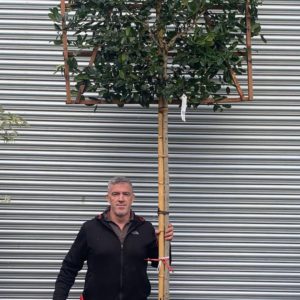
Ilex Nellie Stevens Standard Espalier
Price range: €625.00 through €650.00 Select options This product has multiple variants. The options may be chosen on the product page -
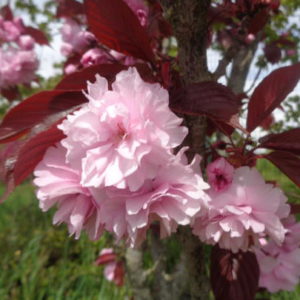
Prunus Royal Burgundy / Red leafed Cherry
Price range: €45.00 through €550.00 Select options This product has multiple variants. The options may be chosen on the product page -
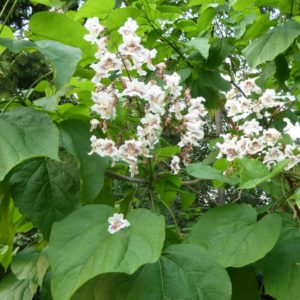
Catalpa biganoides / Indian Bean Tree
€440.00 Select options This product has multiple variants. The options may be chosen on the product page -
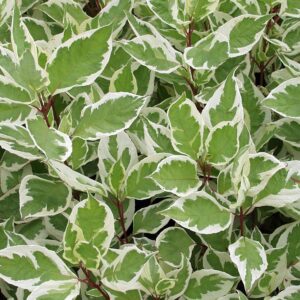
Cornus alba Ivory Halo
€20.00 Select options This product has multiple variants. The options may be chosen on the product page