

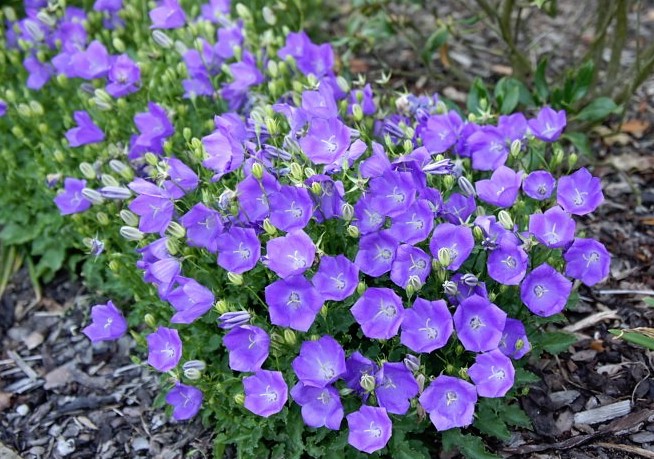
Campanula carpatica ‘Blue Clips’
€8.50
Frequently Bought Together

Description
Quick Facts
– Botanical Name: Campanula carpatica ‘Blue Clips’
– Common Name: Carpathian Bellflower ‘Blue Clips’
– Plant Type: Hardy herbaceous perennial
– Mature Height: 15–25cm
– Mature Spread: 25–30cm
– Flowering Period: Early summer, weeks of bloom if deadheaded regularly
– Flower Colour: Clear medium blue, upward-facing open bells
– Foliage: Small green leaves forming a low, cushion-shaped mound
– Aspect: Full sun to partial shade
– Soil: Well-drained soil; good drainage essential
– Hardiness: Very hardy — one of the most reliable perennials in our climate
– Maintenance: Low — regular deadheading and occasional division
Description
Campanula carpatica ‘Blue Clips’ is one of the most dependable and accommodating of all the bellflowers — a low, cushion-shaped mound of small green leaves that comes alive in early summer with an abundance of upward-facing, open bells in a clear, cheerful medium blue. It is the kind of plant that excels at the small, precise jobs in the garden: edging a path, filling a rockery, fronting a border, or spilling from a container — and it does them all with a relaxed, generous ease that few plants match.
It also performs especially well in our climate, where the cool summer nights suit it perfectly. With a little regular deadheading, the display continues for weeks — and because the whole plant stays neat and contained at little more than hand height, keeping it flowering is an easy and satisfying task rather than a chore.
Caragh Garden Notebook
Planting:
Plant in spring or autumn into well-drained soil — good drainage is the one condition this plant genuinely requires and the single most important factor in its success. It thrives in full sun to partial shade; in our climate, full sun with cool night temperatures gives the best flowering display. Excellent in rock gardens, at the front of a border, along the edge of a path, or in containers, where its low, cushion shape can be properly appreciated. Water in thoroughly after planting.
Watering:
Water consistently through the first growing season while roots establish. Once settled, ‘Blue Clips’ is reasonably tolerant of drier conditions and performs best with sharp drainage rather than constant moisture. In containers, water regularly through the growing season but ensure the compost never becomes waterlogged — good drainage in the pot is as important as it is in the ground. Overwatering, particularly in winter, is more of a risk than drought.
Feeding:
Feed sparingly. A light application of a balanced slow-release fertiliser in spring supports healthy growth and good flowering; in reasonably fertile soil, no further feeding is needed through the season. In containers, a weak balanced liquid feed every few weeks through the growing season will keep the plant flowering well. Avoid rich or heavy feeding, which can encourage lush, soft growth at the expense of the compact cushion form.
Deadheading & Seasonal Care:
Regular removal of spent blossoms is the key to an extended display — clipping off faded flowers down to the base of their stems encourages the plant to produce a fresh succession of blooms, keeping the cushion covered in blue for weeks rather than fading after the first flush. Once flowering has finished in late summer, the mound can be tidied lightly to keep it neat for the remainder of the season.
Division:
Divide every three to four years in spring or autumn to maintain vigour and prevent the centre of the cushion from dying out. Lift the clump carefully, divide into sections each with a healthy crown and root system, and replant immediately into well-prepared, well-drained soil. Division is also the simplest method of propagation — divisions establish readily and can be used to spread the plant along an edge or through the rockery. Water in thoroughly after dividing.
Pests & Problems:
Generally trouble-free and very hardy. Slugs and snails can occasionally target the young growth and flowers, particularly in damp conditions — vigilant monitoring in spring is worthwhile. The most common problem is poor drainage, which causes the crown to rot, particularly over winter; planting in well-drained soil with a little grit or gravel incorporated is the most reliable prevention. In hot, dry positions the plant may flower a little less generously, but in our cool-summer climate it performs particularly well.
Design Notes:
The low, cushion habit and clear blue flowers make ‘Blue Clips’ one of the most useful of all edging and rock-garden plants. Use a row of it along the front of a sunny border to create a crisp, flowering edge that holds its shape and colour through early summer; tuck individual plants between stones in a rockery or into the crevices of a dry-stone wall; or plant in a shallow container or alpine trough where the neat mound and upturned blue bells can be seen at close range. The medium blue pairs beautifully with soft yellows, creams, and silver foliage, and works well alongside other rock-garden favourites — dianthus, saxifrage, and low-growing sedums. In a sunny patio container, it provides weeks of reliable colour with very little effort, and the divided offsets will keep the display going through many years.
Additional information
| Pot Size |
|---|
Related products
-
Carpinus betulus / Hornbeam
Price range: €320.00 through €750.00 Select options This product has multiple variants. The options may be chosen on the product page -

Carpinus betulus Fastigiata / Upright Hornbeam
Price range: €170.00 through €750.00 Select options This product has multiple variants. The options may be chosen on the product page -
Campanula alliariifolia
€8.50 Select options This product has multiple variants. The options may be chosen on the product page -

Thymus serpyllum
€9.50 Select options This product has multiple variants. The options may be chosen on the product page