

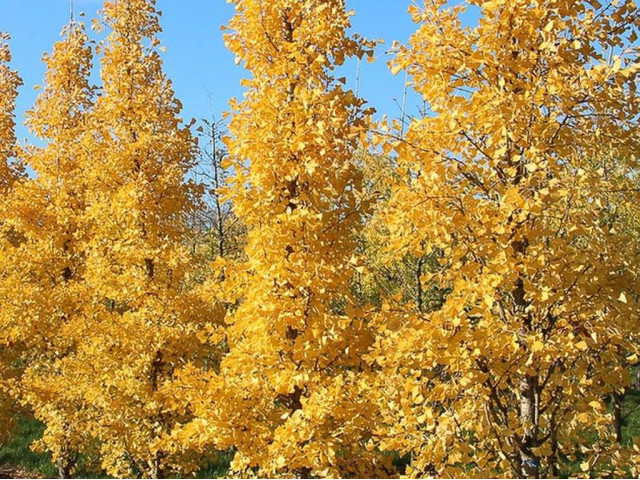
Ginkgo biloba ‘André Briant’
€30.00
Frequently Bought Together

Description
Quick Facts
- Common Name: Fastigiate Maidenhair Tree, Columnar Ginkgo
- Botanical Name: Ginkgo biloba ‘André Briant’
- Plant Type: Deciduous conifer tree
- Mature Height: 10-15m
- Mature Spread: 2-3m
- Flowering Period: April to May (insignificant flowers)
- Flower Colour: N/A (grown for foliage and form)
- Foliage: Unique fan-shaped leaves, fresh green turning spectacular golden-yellow in autumn
- Hardiness: RHS H7 (fully hardy throughout UK and Ireland)
- Soil Requirements: Well-drained, fertile soil; tolerates wide range of conditions
- Aspect: Full sun to partial shade
- Maintenance: Very low
Description
Experience the breathtaking beauty of Ginkgo biloba ‘André Briant’, one of the most striking and architectural fastigiate trees for gardens, where narrow columnar form, unique fan-shaped foliage, and spectacular golden-yellow autumn colour combine to create living sculptures of extraordinary presence that bring year-round architectural interest and unforgettable seasonal displays to gardens with exceptional reliability and minimal maintenance making this perfect for adding substantial vertical accent without occupying excessive ground space. This exceptional cultivar offers remarkable qualities—spectacular narrow columnar habit growing 10-15m tall yet only 2-3m wide creating dramatic vertical accent and space-efficient presence perfect for smaller gardens, driveways, and formal plantings where traditional spreading trees are too large, unique fan-shaped leaves unlike any other hardy tree creating extraordinary botanical interest and prehistoric character, breathtaking autumn colour transformation when fresh green foliage turns luminous golden-yellow creating glowing displays that rival the finest autumn trees, ancient living fossil status as the sole survivor of a plant group dating back 270 million years connecting gardens to deep prehistoric heritage, and exceptional hardiness and adaptability thriving in urban pollution, challenging soils, exposed positions, and wide range of conditions with remarkable resilience, making this one of the most rewarding and distinctive choices for adding substantial vertical presence, unique foliage, spectacular autumn colour, and living history to avenues, formal gardens, and anywhere architectural columnar form with seasonal drama is desired.
Throughout the seasons, this captivating tree displays its characteristic unique foliage—the leaves are fan-shaped (flabellate) measuring 5-12cm wide, with distinctive bilobed form creating two rounded lobes separated by central notch giving the appearance of a butterfly or oriental fan. The leaf shape is unlike any other hardy tree, creating instant recognition and extraordinary botanical interest. The leaves have parallel veins radiating from the leaf stalk (petiole) creating beautiful linear pattern visible when backlit. The foliage emerges in spring (April-May) as fresh bright green creating beautiful spring colour, then matures to rich mid-green throughout summer providing lush canopy. The leaves are arranged alternately on short spur shoots and more sparsely on long shoots, creating interesting textural variation. In autumn (October-November), the foliage undergoes spectacular transformation—leaves turn luminous golden-yellow to butter-yellow creating breathtaking displays of pure gold that glow in autumn sunlight. The autumn colour develops suddenly, often transforming the entire tree within a few days, and the display typically lasts 1-2 weeks before leaves drop simultaneously creating a golden carpet beneath the tree—this sudden transformation and leaf drop is characteristic of Ginkgo and adds to the dramatic seasonal effect. The growth habit is the cultivar’s defining feature—’André Briant’ grows in narrow columnar form with strongly upright branches held close to the central trunk creating elegant fastigiate silhouette. Young trees are particularly narrow and columnar, gradually broadening slightly with age but maintaining distinctly upright character throughout life. Mature trees typically reach 10-15m tall and only 2-3m wide, making this one of the narrowest Ginkgo cultivars available and perfect for restricted spaces. The bark on young trees is smooth grey-brown, becoming deeply furrowed and corky with age developing attractive rugged character. The overall effect is architectural, prehistoric, and seasonally spectacular—like having a living golden column or ancient sentinel in the garden with unique fan-shaped foliage connecting you to 270 million years of botanical history.
Native to a small area of eastern China where it survived in temple gardens and may no longer exist truly wild, Ginkgo biloba is one of the most extraordinary trees on Earth—a “living fossil” and the sole surviving member of the ancient order Ginkgoales which flourished worldwide during the Jurassic and Cretaceous periods (200-65 million years ago) when dinosaurs roamed. All other members of this ancient plant group are extinct, making Ginkgo the oldest living tree species and a direct link to prehistoric forests. The genus name ‘Ginkgo’ is derived from the Japanese ‘ginkyo’ meaning “silver apricot,” referring to the seeds. The species name ‘biloba’ means “two-lobed,” describing the distinctive leaf shape. Ginkgo has been cultivated in China for over 1,000 years, particularly around Buddhist temples where it was considered sacred, and was introduced to Europe in the early 18th century. It’s now widely planted worldwide for its extraordinary botanical interest, spectacular autumn colour, and exceptional urban tolerance—Ginkgo survived the atomic bombing of Hiroshima in 1945, with trees near ground zero resprouting and still thriving today, testament to its remarkable resilience. ‘André Briant’ is a French selection named after the nurseryman who discovered it, selected specifically for its narrow columnar habit making Ginkgo suitable for smaller gardens and formal plantings where the species’ typical spreading form is too large. Hardy to RHS H7, this exceptionally robust tree thrives throughout temperate climates with complete reliability, tolerating severe cold (to -30°C or below), urban pollution (one of the most pollution-tolerant trees), challenging soils, and exposed positions. Slow to moderate growth rate, adding 20-30cm annually, reaching impressive size within 20-30 years. Particularly valuable for narrow columnar habit perfect for restricted spaces, driveways, and formal plantings, unique fan-shaped foliage creating extraordinary botanical interest, spectacular golden-yellow autumn colour, exceptional urban tolerance and adaptability, and ancient living fossil status connecting gardens to prehistoric heritage. The narrow form and seasonal drama make this outstanding for formal avenues and architectural plantings.
Create stunning compositions by planting in pairs flanking driveways, entrances, or pathways creating formal symmetry and dramatic vertical accents that frame views without occupying excessive space, using in avenues where repeated trees create spectacular formal rhythm and golden autumn displays along approaches, or positioning as specimen in formal gardens where the narrow columnar form and unique foliage create architectural focal points and living sculptures. Exceptional in small gardens and courtyards where the narrow habit fits perfectly providing substantial presence without overwhelming the space or casting excessive shade, urban gardens where the exceptional pollution tolerance makes it one of the most reliable trees for challenging city conditions, or contemporary landscapes where the architectural form and prehistoric character create modern minimalist aesthetic. Works beautifully in mixed borders as vertical accent providing height and structure without spreading, combined with evergreen backdrop (yew hedging, holly, Osmanthus) that emphasizes the unique fan-shaped foliage and golden autumn colour, or underplanted with shade-tolerant perennials and bulbs (hostas, ferns, hellebores, spring bulbs) that thrive beneath the light canopy. Also magnificent in formal courtyards and paved areas where the narrow habit suits restricted planting spaces, as street trees where the columnar form and urban tolerance excel, or in Japanese-inspired gardens where the tree’s Asian heritage and architectural form fit perfectly with the aesthetic. Perfect for adding substantial vertical presence, unique foliage, spectacular autumn colour, and living history to avenues, formal gardens, and anywhere architectural columnar form with seasonal drama is desired. IMPORTANT: Ginkgo are dioecious (separate male and female trees)—’André Briant’ is typically sold as male clones which do not produce the malodorous fruits that female trees produce, making it ideal for gardens and urban plantings.
Caragh Garden Notebook
Planting: Space trees 3-4m apart for avenue plantings where narrow crowns will remain distinct creating formal rhythm, or plant as individual specimens with room to develop full columnar form. Plant bare-root specimens November-March during dormancy (ideal for best establishment and value), or container-grown specimens year-round though autumn or early spring is preferred. Choose position in full sun for best growth and most spectacular autumn colour—tolerates partial shade but growth may be slower and autumn colour less intense. Requires open position with room for vertical growth—the narrow habit makes this suitable for planting near buildings and in restricted spaces where spreading trees are inappropriate. Dig generous planting hole at least twice width of root ball and same depth. Incorporate organic matter (well-rotted compost, leaf mould) into backfill soil to improve fertility and moisture retention. Plant at same depth as nursery soil mark on trunk—avoid planting too deeply. Backfill carefully, firming soil gently to eliminate air pockets. Water thoroughly after planting. Apply 8-10cm mulch of organic matter around base in 1m diameter circle, keeping mulch clear of trunk (10cm gap) to prevent rot. Stake young trees using single stake or double stakes—use tree ties with spacers. Stakes support tree for first 3-4 years. Water regularly during first 2-3 growing seasons to establish deep root system. Position where the narrow columnar form and spectacular autumn colour can be appreciated.
Soil Preparation: Tolerates remarkably wide range of soil types including sandy, loamy, clay, and even poor soils—one of the most adaptable trees for challenging conditions. Prefers neutral to slightly acidic pH (6.0-7.0) but tolerates slightly alkaline conditions. Requires well-drained soil—avoid waterlogged or poorly drained soils which can cause root problems, though Ginkgo is more tolerant of occasional wet conditions than many trees. Prefers fertile soil for best growth but tolerates poor soils once established. Improve heavy clay soils by incorporating organic matter and grit to improve drainage. Improve light sandy soils by adding compost or well-rotted manure to improve moisture retention and fertility. Mulch annually in spring with 8-10cm layer of organic matter around base to conserve moisture, suppress weeds, and improve soil fertility. Keep mulch clear of trunk. Best growth and autumn colour occur in full sun with well-drained, fertile soil—these conditions produce the most vigorous growth and most spectacular golden autumn displays.
Container Growing: Can be grown in large containers when young, though will eventually require in-ground planting as tree matures. Use very large container (minimum 60-80cm diameter), soil-based compost (John Innes No. 3), and ensure excellent drainage. Position in full sun. Water regularly during growing season. Feed in spring with slow-release balanced fertiliser. Plan for permanent in-ground planting within 3-5 years as tree outgrows container.
Seasonal Care: Requires minimal pruning—the naturally columnar form develops without intervention and maintains narrow upright habit throughout life. Prune only to remove dead, damaged, or crossing branches, or to maintain single central leader if competing leaders develop. Carry out any necessary pruning in late autumn to winter (November-February) during dormancy. Avoid removing lower branches unless necessary as the columnar form is most effective when branches extend close to ground level. Apply general-purpose balanced fertiliser or blood, fish and bone in spring around base to promote healthy growth. Mulch annually in spring. Water regularly during dry spells during first 5-7 years of establishment—once established, deep roots make tree remarkably drought-tolerant. Generally pest and disease free—Ginkgo has no serious pest or disease problems and is one of the most resilient trees available, likely due to its ancient lineage and unique biochemistry. The spectacular golden autumn colour is reliably breathtaking!
Propagation: Cannot be propagated by home gardeners—this cultivar is created by grafting onto Ginkgo biloba rootstock, a specialist technique requiring professional nursery facilities. Can also be propagated from hardwood cuttings taken in winter, though success rate is low and trees take many years to develop. Cannot be grown from seed as seedlings will not come true to type and will not maintain the narrow columnar habit. Nursery-grown grafted specimens are essential for guaranteed narrow form and male sex (avoiding malodorous fruits).
This spectacular beauty is absolutely breathtaking—one of the finest columnar trees available! That narrow fastigiate habit growing 10-15m tall yet only 2-3m wide is absolutely stunning—dramatic vertical accent perfect for restricted spaces! Unique fan-shaped leaves unlike any other hardy tree creating extraordinary botanical interest and prehistoric character. Breathtaking autumn colour transformation to luminous golden-yellow creating glowing displays—leaves drop suddenly creating golden carpet! Ancient living fossil—sole survivor of plant group dating back 270 million years connecting you to prehistoric forests! Exceptional hardiness (RHS H7) and urban tolerance—one of the most pollution-tolerant trees! Slow to moderate growth (20-30cm annually). Virtually no maintenance required. Generally pest and disease free. IMPORTANT: Typically sold as male clones—no malodorous fruits! Perfect for avenues, formal gardens, driveways, small gardens, urban plantings, and anywhere you want substantial vertical presence with unique foliage, spectacular autumn colour, and living history. Pure architectural magnificence and golden column!
Related products
-

Malus sylvestris / Crab Apple Tree
€320.00 Select options This product has multiple variants. The options may be chosen on the product page -
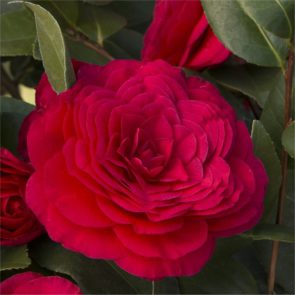
Camellia Japonica Rosso
Price range: €195.00 through €240.00 Select options This product has multiple variants. The options may be chosen on the product page -
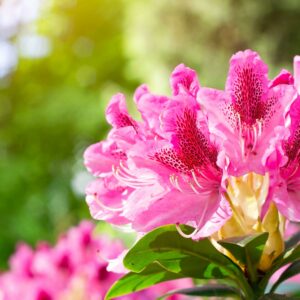
Rhododendron Cosmopolitan
€120.00 Select options This product has multiple variants. The options may be chosen on the product page -

Prunus cerasifera ‘Pissardii’
Price range: €150.00 through €450.00 Select options This product has multiple variants. The options may be chosen on the product page