

Some gardens at Chelsea stop you in your tracks for obvious reasons — the scale, the spectacle, the budget that’s clearly been spent.
And then there are the ones that stop you for a quieter reason. They have a story. You feel it before you’ve read a single word on the sign.
Max Parker Smith’s ‘Journey Beyond the Tracks: From Adelaide to Perth‘ was that garden for me this year.
The Journey That Inspired It
The concept is simple and genuinely brilliant: a rail journey. Specifically, the Indian Pacific one of the great train routes of the world, running from Adelaide to Perth through the extraordinary landscape of Southern and Western Australia.
Parker Smith took that journey and built a garden around it. Not a literal recreation, but an interpretation of plants, materials, and spaces that reflect what you’d see, feel, and move through along that route.
The result was awarded a Silver-Gilt Medal. Deserved.
What the Garden Actually Does
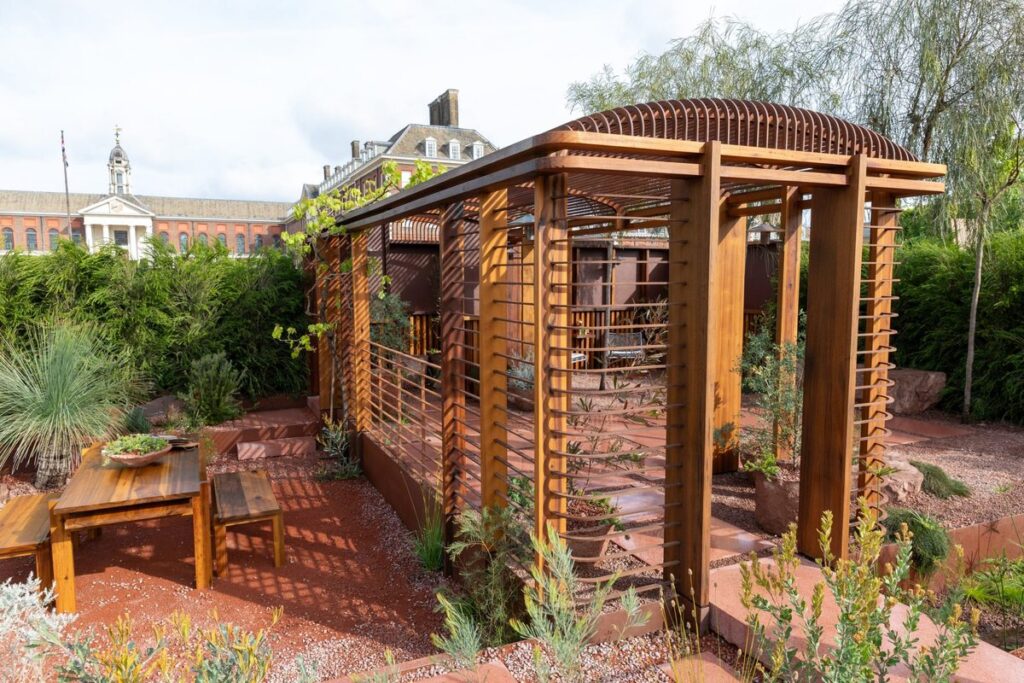
The structure is led by a train carriage frame a deliberate, architectural starting point that gives the garden its backbone and its narrative.
From there, it splits into two distinct worlds:
On one side, tiered beds planted with climate-resilient species typical of Western Australia — textural, low-water, quietly dramatic. On the other, a celebration of Adelaide as a national park city, with trees and a natural water corridor that feel grounded and generous.
What holds it together is the idea that both environments exist along the same journey. You’re moving through the garden the way you’d move through a landscape noticing the shift, the change, the difference in what each place asks of you.
The central dining space is planted with sand-loving species a nod to the 8,000 endemic plants of Western Australia, many of which most people in the Ireland have never seen in the ground before.
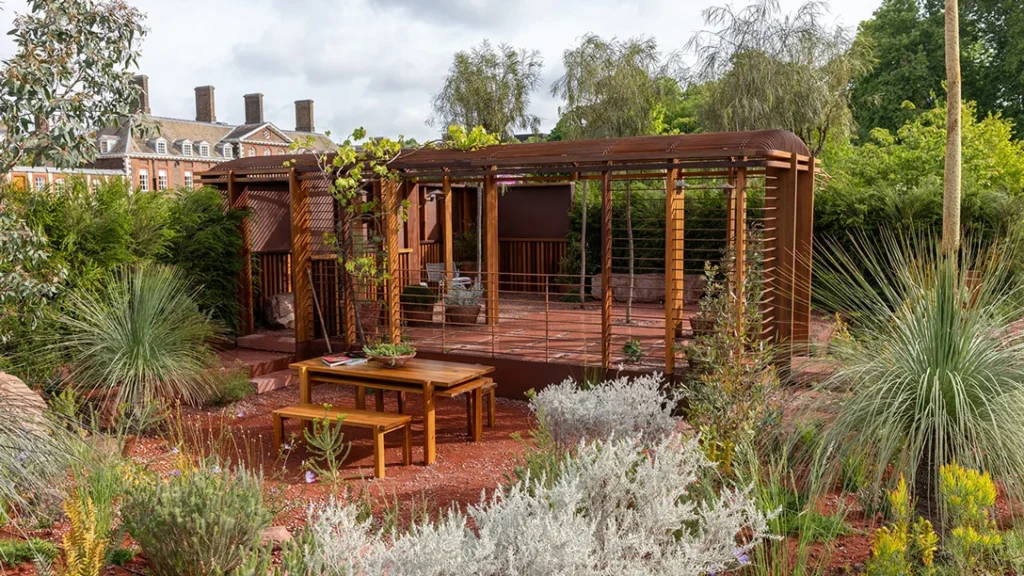
Inside the pergola, modern timber panelling creates a quiet seating area. It’s one of those spots that makes you want to stay rather than move on.
Why the Materials Matter
Sustainability runs through this garden in a way that feels honest rather than performative.
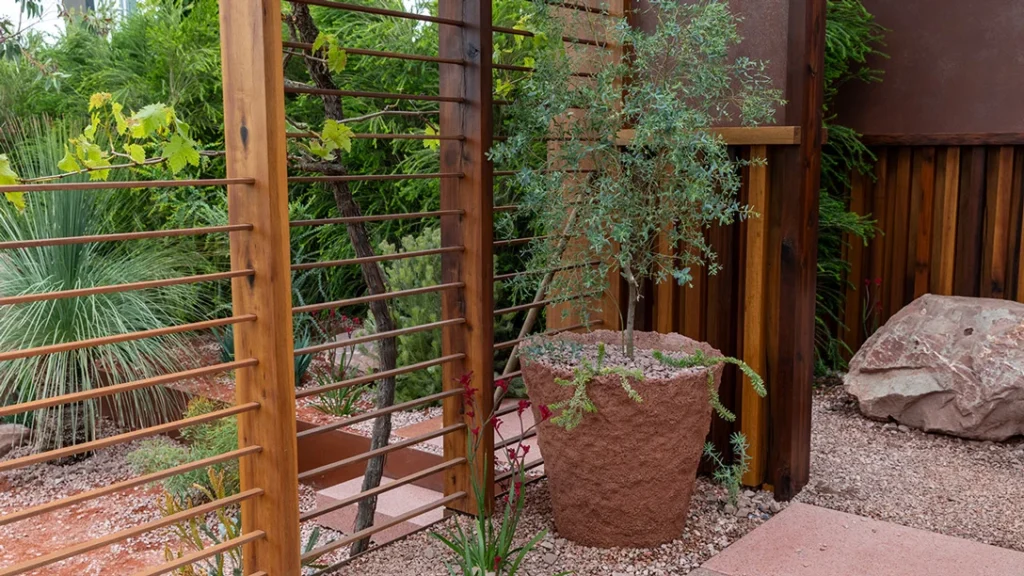
Natural stone. Local aggregates. Low-carbon metal. None of it feels like a box being ticked, it gives the garden its weight, its character, and its sense of being rooted somewhere specific rather than generic.
That combination of regional character and environmental responsibility is something more gardens and more clients are asking for. Parker Smith delivers it without making a noise about it. It’s just there, in the fabric of the space.
The Planting Palette
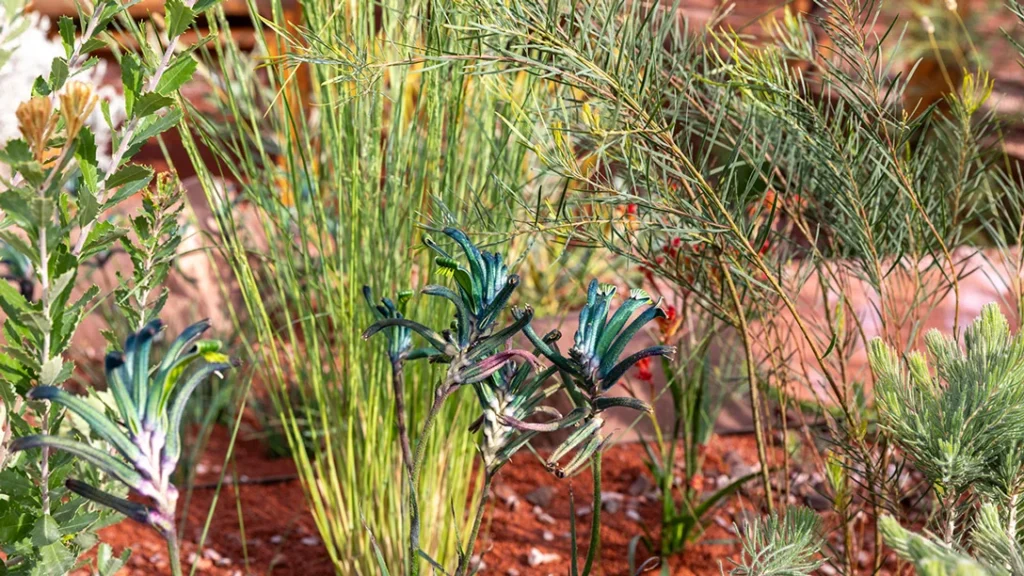
The colour palette that comes with them is worth noting: muted greens, scattered blues, and the occasional burst of hot colour from the flowers. It’s earthy and warm, never overdone.
We can’t replicate this garden exactly in our temperate climate and we wouldn’t try to. But the principles? Entirely stealable.
- Eucalyptus as a fast-growing structural tree — plant young, let it establish, and it’ll do serious work within a season or two
- Callistemon against a warm wall or in a sheltered spot — it’s hardier than people think and the flowers are genuinely striking
- Anigozanthos in a sunny, free-draining bed — pair it with grasses or low sedums for that same layered, naturalistic feel
- Use Corten steel for raised beds, edging, or simple planters — the warm rust tone sits beautifully against the earthy greens and golds of this kind of palette, and it only improves with age
- Repeat a key plant or shape across the space to give it rhythm and intention
What It Made Me Think About
This garden is an ode to biodiversity — to the 450+ national parks and reserves across Southern Australia, to the sheer abundance of plant life that most of us will never see in person.
There’s something genuinely humbling about that. A garden that reminds you how much exists beyond what you already know.
That’s what the best Chelsea gardens do. They don’t just show you something beautiful. They make you curious.
Want to bring something of this into your own garden? We’re here to help — from specimen trees and architectural planting to the materials that give a garden its bones. Come and find us at Caragh Nurseries, or get in touch and we’ll point you in the right direction.