
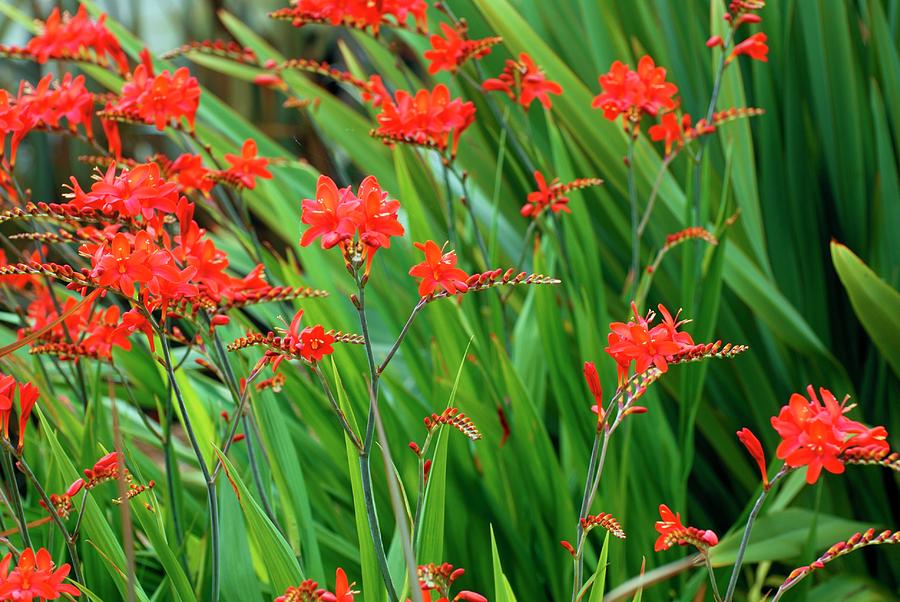
Crocosmia Lucifer
€9.50
Frequently Bought Together



Description
Quick Facts
Botanical Name: Crocosmia ‘Lucifer’
Common Name: Montbretia
Plant Type: Deciduous perennial (corm-forming)
Mature Height: 90–120cm
Mature Spread: 30–45cm
Flowering Period: Midsummer (July–August)
Flower Colour: Intense scarlet-red
Foliage Colour: Bright green, upright sword-like leaves
Hardiness: Very hardy in Ireland & the UK
Soil Requirements: Well-drained, moderately fertile soil
Aspect: Full sun to light shade
Maintenance: Low
Description
Crocosmia ‘Lucifer’ is one of the most reliable and impactful plants you can put in a summer border. The colour is extraordinary — a pure, intense scarlet-red that catches the eye from across the garden. Arching sprays of tubular flowers open in succession along each stem through July and August, held above bold, upright, sword-like foliage that earns its place even before the flowers appear. It spreads steadily over time, forming generous clumps that get better year on year. Tough, long-lived, and genuinely low-maintenance — it’s as hardworking as it is dramatic.
Caragh Garden Notebook
Planting:
Plant corms in spring, 8–10cm deep and 15–20cm apart, in well-drained soil. They establish quickly and will begin flowering in their first season. In heavier soils, work in some grit to improve drainage before planting.
Watering:
Water regularly through the first growing season to help corms establish. Once settled, Crocosmia is reasonably drought-tolerant, though a drink during prolonged dry spells through summer will support better flowering.
Feeding:
A light mulch of compost in spring is sufficient for plants in the ground. In containers, apply a balanced liquid feed every few weeks through the growing season to keep growth strong.
Seasonal Care & Tidy-Up:
Leave the foliage in place through autumn — it continues to feed the corms as it dies back. Cut back to ground level in late autumn or early spring before new growth emerges. In colder or more exposed gardens, a light mulch over the crown in winter provides useful protection.
Division (to keep plants vigorous):
Clumps spread steadily and benefit from dividing every 3–4 years in spring. Lift, separate, and replant — it’s a straightforward job and gives you plenty of new plants to spread through the border or pass on.
Pests & Problems:
Generally trouble-free. In very heavy, wet soils corms can rot over winter — good drainage at planting is the best prevention. Spider mites can occasionally affect foliage in hot, dry summers but are rarely a serious issue.
Design Notes:
A natural in hot-coloured borders alongside Heleniums, Rudbeckias, Hemerocallis, and red or orange Dahlias — ‘Lucifer’ holds its own among the boldest summer plants. It also creates stunning contrast planted near deep purples and blues, such as Agapanthus or Salvia. The upright, strappy foliage adds strong vertical structure from spring onwards, and the plant looks particularly effective massed in large drifts where the scarlet flower sprays create a real wash of colour through midsummer.
Additional information
| Pot Size |
|---|
Related products
-
Fatsia japonica
€12.50 Select options This product has multiple variants. The options may be chosen on the product page -
Rhododendron Nova Zembla
€60.00 Select options This product has multiple variants. The options may be chosen on the product page -
Canna Tenerife
€15.00 Select options This product has multiple variants. The options may be chosen on the product page -
Yucca Golden Sword
€25.00 Select options This product has multiple variants. The options may be chosen on the product page