

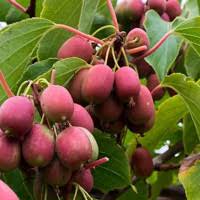
Actinidia Ananasnaya (Hardy Kiwi)
€25.00
Description
Quick Facts
- Common Name: Hardy Kiwi, Kiwi Berry ‘Ananasnaya’
- Botanical Name: Actinidia arguta ‘Ananasnaya’
- Plant Type: Deciduous, vigorous climbing fruit vine
- Mature Height: 4–6m+ (with support; can be kept smaller with pruning)
- Mature Spread: 3–5m
- Flowering Period: June (small, creamy-white flowers)
- Fruit: Smooth-skinned, grape-sized kiwi berries; sweet with a tropical/pineapple note; harvest late summer to autumn
- Hardiness: Very hardy (UK & Ireland)
- Soil Requirements: Moist, well-drained, fertile soil
- Aspect: Full sun to part shade (best fruiting in sun, sheltered from cold winds)
- Maintenance: Moderate (training + annual pruning)
Description
Actinidia ‘Ananasnaya’ is the hardy kiwi with a little bit of magic in it—vigorous, beautiful, and wonderfully productive once it settles in. Unlike the supermarket kiwi, these fruits are small, smooth-skinned and eaten whole (no peeling), with a sweet flavour that often carries a gentle tropical, pineapple-like note.
In early summer, the vine produces small creamy-white flowers, followed by clusters of kiwi berries that swell through late summer and autumn. The plant itself is handsome too: fresh green leaves, strong growth, and that lush, climbing habit that’s perfect for covering a pergola, fence, arch or sunny wall.
Hardy kiwi is a brilliant “edible climber” for Irish and UK gardens—especially if you want something a little different from the usual berries and fruit trees. Give it good soil, steady moisture, and a sturdy support, and it will reward you year after year.
Caragh Garden Notebook
Planting:
Plant in spring or autumn. Choose a sunny, sheltered spot (a warm wall, pergola, or fence is ideal) and make sure you have a strong support system in place before planting—this vine gets vigorous. Dig a generous hole and improve the soil with plenty of compost or well-rotted manure. Plant at the same depth as in the pot, firm in, water well, and mulch.
Plant in spring or autumn. Choose a sunny, sheltered spot (a warm wall, pergola, or fence is ideal) and make sure you have a strong support system in place before planting—this vine gets vigorous. Dig a generous hole and improve the soil with plenty of compost or well-rotted manure. Plant at the same depth as in the pot, firm in, water well, and mulch.
Soil Preparation:
Best in moist, fertile, free-draining soil. Avoid waterlogged ground, but don’t let it dry out either—consistent moisture supports good fruit set and swelling. Mulch annually to feed the soil and protect roots.
Best in moist, fertile, free-draining soil. Avoid waterlogged ground, but don’t let it dry out either—consistent moisture supports good fruit set and swelling. Mulch annually to feed the soil and protect roots.
Training (worth doing early):
Train the main stems along wires or a pergola beam, then allow fruiting side shoots to develop. Good training makes pruning easier and improves light and airflow (which helps fruiting).
Train the main stems along wires or a pergola beam, then allow fruiting side shoots to develop. Good training makes pruning easier and improves light and airflow (which helps fruiting).
Pruning (simple, once you know the rhythm):
- Winter prune: remove overcrowded growth and shorten last season’s fruiting shoots.
- Summer prune: trim long whippy growth back to keep the plant tidy and to direct energy into fruit.
(If you’d like, tell me how you’re training it—pergola vs wires—and I’ll tailor a super-simple pruning guide to match.)
Watering:
Water regularly in the first year and during dry spells. Fruiting plants in particular appreciate steady moisture from flowering through fruit swell.
Water regularly in the first year and during dry spells. Fruiting plants in particular appreciate steady moisture from flowering through fruit swell.
Pollination (important):
Most Actinidia arguta varieties crop best with a male pollinator nearby.
Most Actinidia arguta varieties crop best with a male pollinator nearby.
Pests & Problems:
Generally trouble-free. Protect young plants from late frost in their first spring if they’re in an exposed spot. Netting may be needed if birds discover the fruit before you do.
Generally trouble-free. Protect young plants from late frost in their first spring if they’re in an exposed spot. Netting may be needed if birds discover the fruit before you do.
Design Notes:
Perfect for pergolas, sunny fences, and edible screening. Lovely mixed with other climbers (or kept solo so it doesn’t outcompete them). A great talking-point plant for kitchen gardens.
Perfect for pergolas, sunny fences, and edible screening. Lovely mixed with other climbers (or kept solo so it doesn’t outcompete them). A great talking-point plant for kitchen gardens.
Additional information
| Pot Size |
|---|
Related products
-
Catalpa biganoides / Indian Bean Tree
€440.00 Select options This product has multiple variants. The options may be chosen on the product page -
Tilia platyphyllos / Large leaved Lime
Price range: €320.00 through €480.00 Select options This product has multiple variants. The options may be chosen on the product page -
Quercus rubra / Red Oak
Price range: €150.00 through €225.00 Select options This product has multiple variants. The options may be chosen on the product page -
Sorbus aria Lutescens / Whitebeam
€520.00 Select options This product has multiple variants. The options may be chosen on the product page