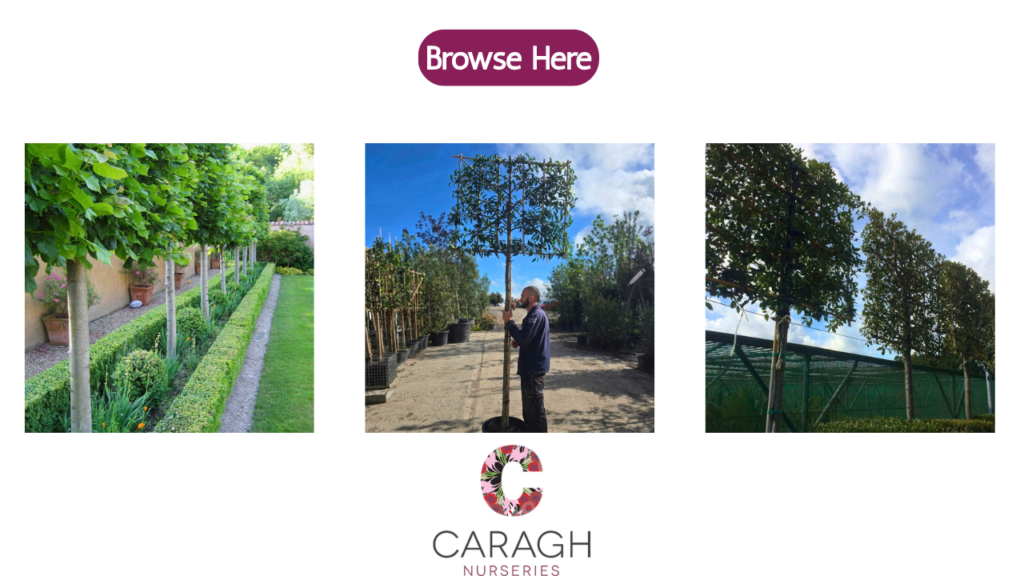

Pleached tree spacing is a common question customer will often ask by showing me a photograph and saying, “How many trees do you think I need?” There is usually a fence in the photograph, perhaps a new extension beyond it, and a lovely bit of garden that does not yet feel quite private.
Before counting trees, I ask where they actually want to sit. Privacy is about the line of sight from that chair or kitchen window. Once we know that, the measurements begin to make sense.
1. Measure the part of the boundary that needs screening
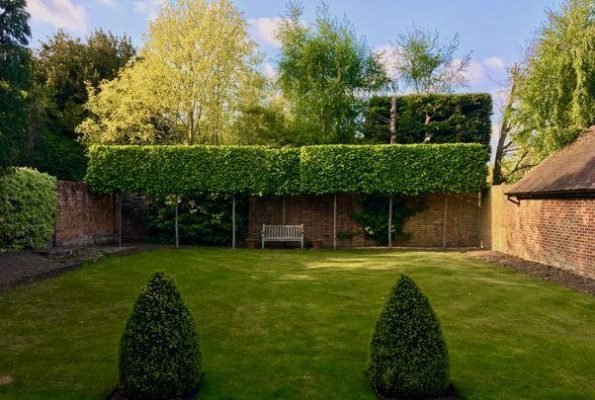
Measure the useful run in metres, then mark any gate, corner or space where a tree cannot be planted. You may only need to cover the view into a patio rather than the full length of a boundary. A row of standard espaliers gives you a raised panel of foliage with clear trunks below; it will not cover a view at ground level unless you plant beneath it.
Take a photograph from the seat or window you want to protect. If you can, take another from the garden looking along the boundary. Those two pictures tell us much more than a photograph of the fence alone.
2. Check where the leafy panel needs to begin
For several trees in our current collection, the clear stem is about 1.8m. That means the trained panel begins around that height, measured from the tree’s planting level. A 100cm-high frame above a 1.8m stem reaches roughly 2.8m at its top; a 120cm-high frame reaches roughly 3.0m. These are approximate supplied-tree dimensions, not a promise of the final visible screen. Ground levels, planting depth, pruning and how full the foliage is all make a difference.
If the ground slopes or the neighbour’s window is high, mark the actual sightline on site. A tall frame can still miss the view if it starts in the wrong place. Also check the specific tree: the stem height of the new ‘Novita’ and ‘Pallida’ batches should be confirmed before relying on a total-height calculation.
3. Use frame width to estimate the number of trees
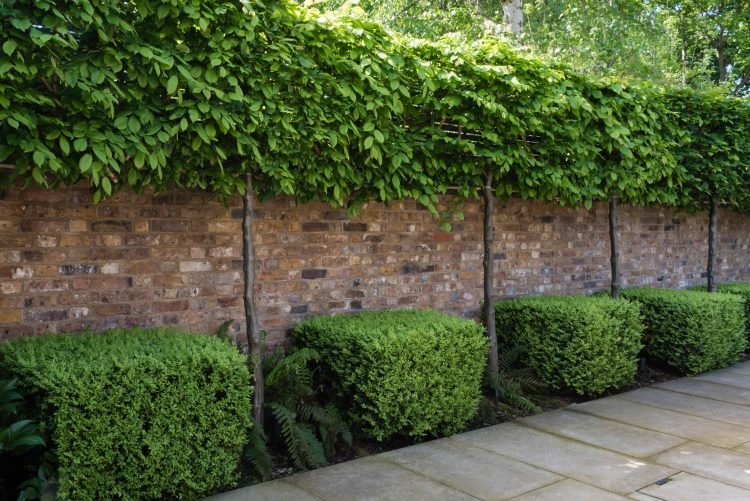
For an initial sketch of a continuous row, use frame width as an approximate centre-to-centre spacing. That places neighbouring panels near one another. It is a planning estimate, not a universal planting rule: the amount of foliage on delivery, expected growth, access for clipping and the exact site may call for a different distance.
| Boundary run | 100cm-wide frames | 120cm-wide frames | 150cm-wide frames |
|---|---|---|---|
| 4.5m | About 5 | About 4 | About 3 |
| 6m | About 6 | About 5 | About 4 |
| 9m | About 9 | About 8 | About 6 |
These numbers divide the run by the frame width and round up. They assume the frames can be placed to cover the intended run, with suitable positions for the end trunks. They do not include an extra tree at each end. Set out the proposed centre points on the ground before ordering, and check boundaries, underground services and room to work around the trees.
For this fresh collection, ‘Brenelia’ has a 100cm-wide frame; Elaeagnus and holm oak have 120cm-wide frames; ‘Novita’, ‘Pallida’ and ‘Chanticleer’ have 150cm-wide frames. Check the exact variant on the product listing, as other sizes may be offered on the same page.
4. Decide how much winter privacy you need
An evergreen screen has foliage through the year, though new espaliers vary in density and need time and care to fill their trained shape. Our Elaeagnus, ‘Novita’ laurel, ‘Brenelia’ Portuguese laurel and holm oak are the year-round choices in this group.
If you want a screen for outdoor living in spring and summer, ‘Pallida’ lime and ‘Chanticleer’ ornamental pear bring the pleasure of changing seasons. In winter their frames and branches remain, but their leaves do not.
5. Plan for establishment and upkeep
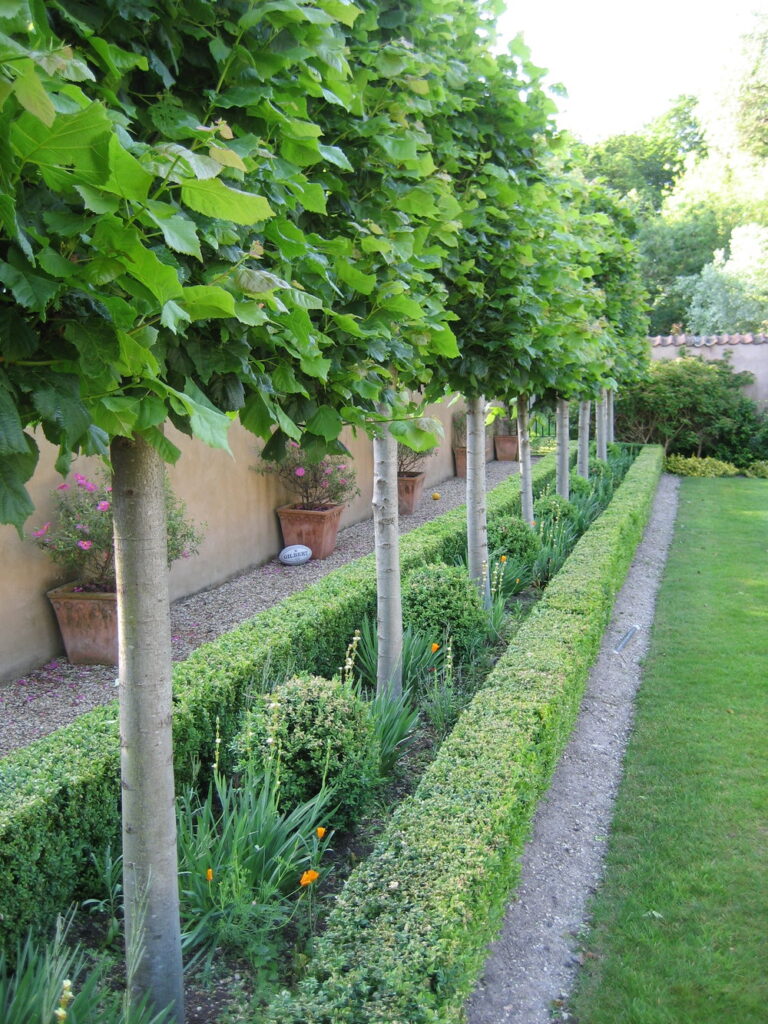
These are living trees, not fence panels. Prepare the planting area, provide appropriate support, water thoroughly after planting and during dry periods while roots establish, and keep the trained form with regular pruning. Leave enough working room on both sides where possible. The right pruning timing and amount depend on the species, so ask us about the trees you choose.
My favourite layouts are the ones planned from the place you will actually enjoy them: the chair by the table, the view from the kitchen, the little corner that catches the evening sun. Measure that view, then choose the frame width and tree that solve it. If you send us a photograph and your boundary measurements, we can help you turn the rough numbers into a planting plan.
For help choosing between the six new arrivals, read Best Espalier Trees for Screening and Privacy in Irish Gardens, or browse our espalier and pleached trees.