

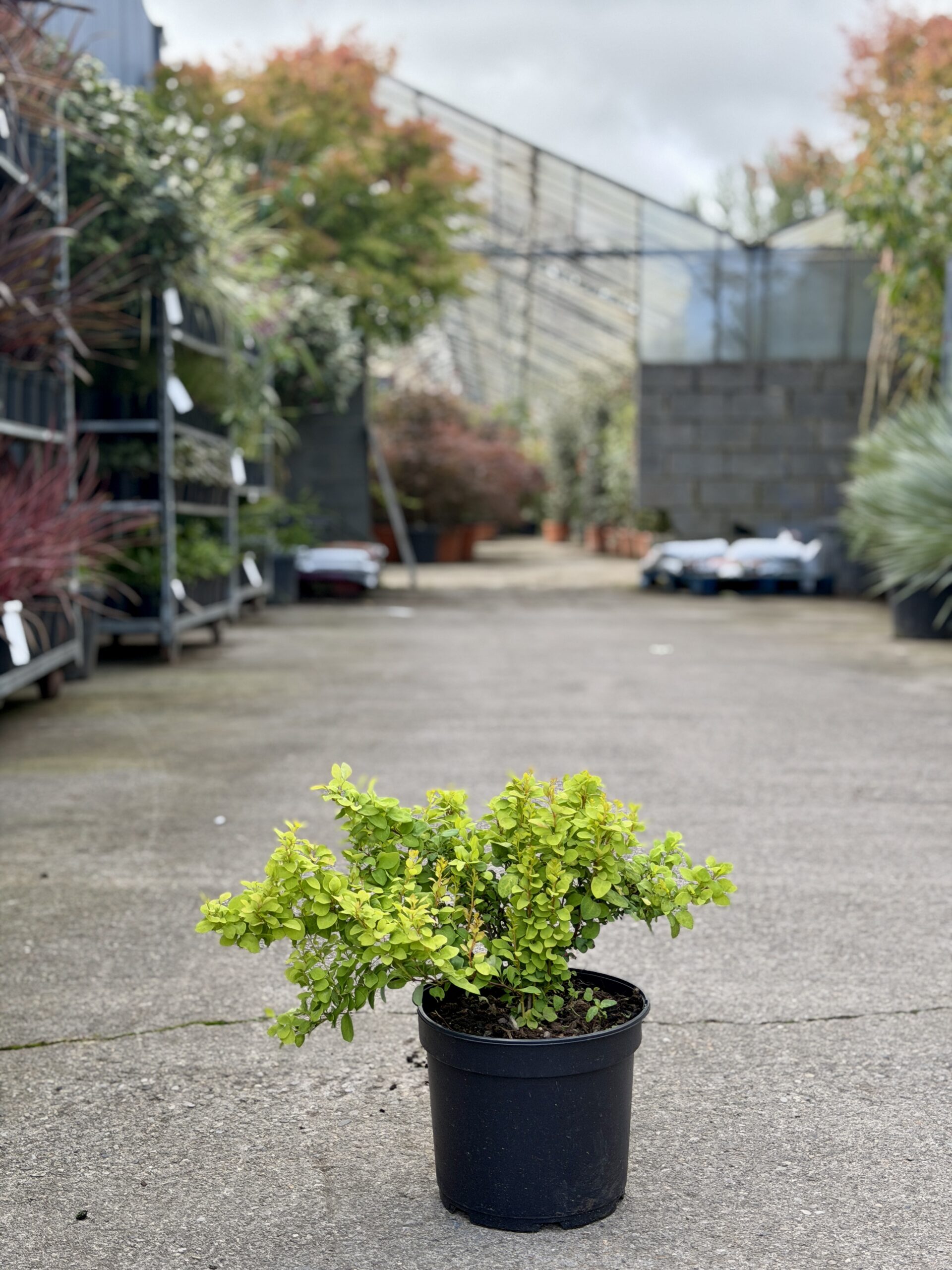
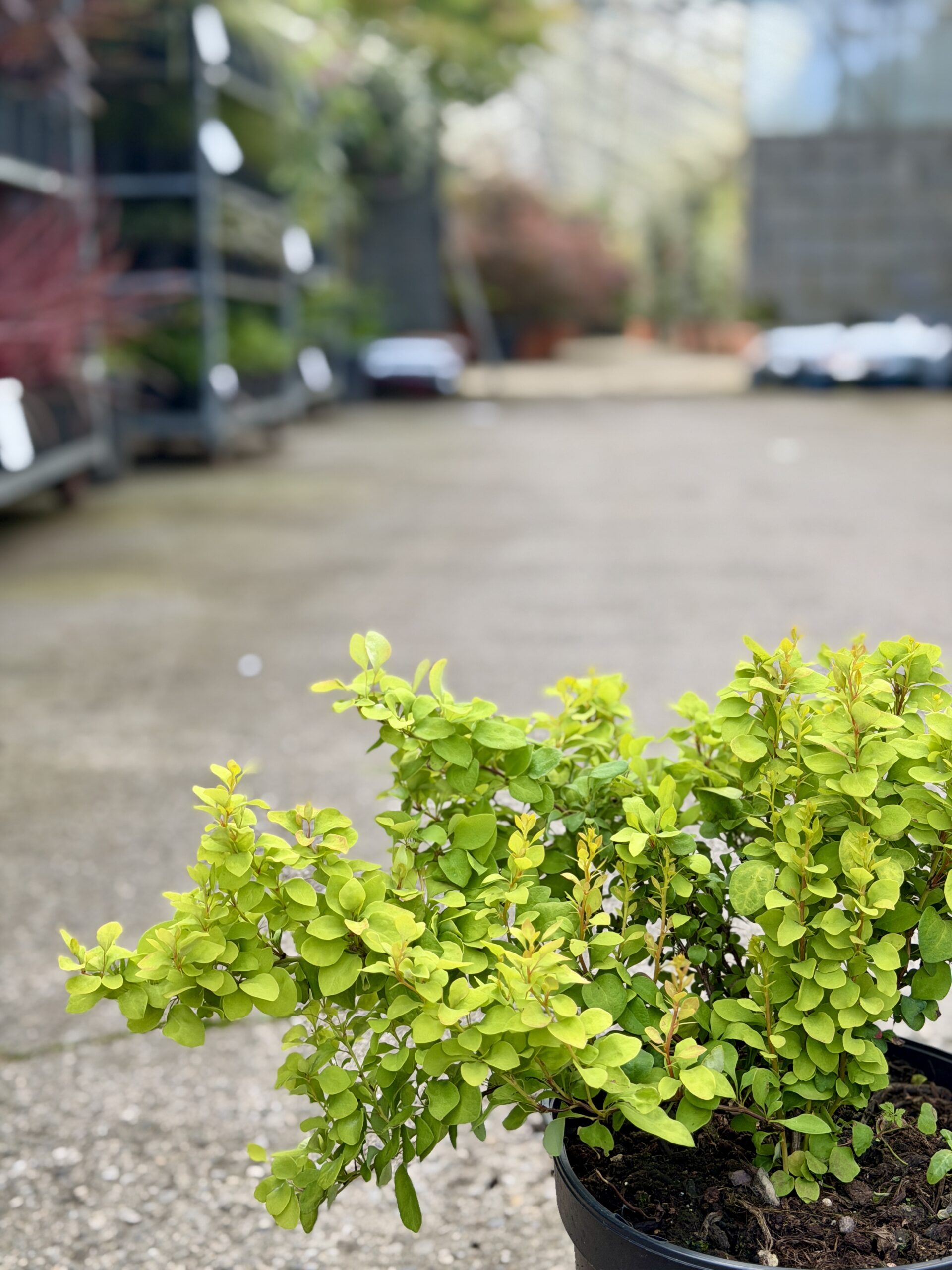
Berberis thunbergii ‘Summer Sunset’
€15.00
Description
Quick Facts
– Botanical Name: Berberis thunbergii ‘Summer Sunset’
– Common Name: Summer Sunset Barberry
– Plant Type: Hardy deciduous shrub
– Mature Height: 60–90cm
– Mature Spread: 60–90cm
– Flowering Period: Late spring — small pale yellow flowers along the stems
– Foliage: Small, rounded leaves with striking cream and silver-margined green variegation; pink tints on new growth — a bright, luminous combination
– Fruit: Glossy red berries in autumn
– Stems: Slender, arching, with fine thorns
– Habit: Compact, rounded, bushy
– Aspect: Full sun to partial shade
– Soil: Well-drained, tolerant of most soil types
– Hardiness: Very hardy in Ireland & the UK
– Maintenance: Very low
Description
Few shrubs bring as much quiet luminosity to a border as Berberis ‘Summer Sunset’. The small, rounded foliage is variegated with cream and silver margins around a fresh green centre, with new growth flushed pink — a combination that looks as though the plant has caught its own private bit of light and kept it. It glows in the border from spring through summer, holds its colour well, and brings a refined, almost jewelled quality to planting that plain green shrubs cannot match.
Compact and rounded at around 60–90cm, it is one of the more accommodating of the barberries — easy to place in a mixed border, at the front of a bed, in a container, or woven through a gravel or cottage scheme. In late spring small pale yellow flowers appear along the stems, followed in autumn by glossy red berries — a sequence of subtle interest that extends the plant’s season well beyond its foliage. Very hardy, very easy, and thorny enough to make a useful informal deterrent along a boundary. A small shrub with real presence.
Caragh Garden Notebook
Planting:
Plant in autumn or early spring into well-drained soil — Berberis is tolerant of most soil types, including poorer and drier soils, and is genuinely one of the easier plants to establish. A position in full sun gives the brightest foliage variegation and the best overall colour; partial shade is tolerated but the cream and pink tones are softer in shadier conditions. Water in thoroughly after planting and allow the plant to establish — it is slow to begin with but settles well and becomes increasingly vigorous with the years.
Watering:
Water consistently through the first growing season while the plant establishes. Once settled, ‘Summer Sunset’ is drought-tolerant and requires little supplementary watering in an Irish garden beyond natural rainfall. During prolonged dry spells, an occasional thorough watering will keep the variegated foliage fresh. In containers, water through the growing season and ensure good drainage.
Feeding:
Feed sparingly. Berberis performs best in reasonably lean conditions and rich, heavily fed soil simply encourages soft growth at the expense of the compact habit and the quality of the variegation. A light balanced fertiliser in spring is plenty for most gardens. In containers, a weak balanced liquid feed every few weeks through the growing season supports healthy growth.
Pruning:
Pruning is minimal and, for most gardeners, unnecessary — the plant’s natural rounded habit is its strength. If any shaping is required, prune in late winter or early spring while the plant is dormant, removing any wayward or crossing stems. Avoid hard pruning into old wood, which berberis is slow to regrow from. Wearing gloves is worthwhile — the stems carry fine thorns that are sharp to the unguarded hand.
Pests & Problems:
Genuinely trouble-free — one of the least demanding shrubs you can grow. It is largely free of pests and diseases and requires very little attention once established. In very heavy, waterlogged soils it will underperform; good drainage at planting is the most reliable safeguard. On established plants, no particular problems are likely to arise.
Design Notes:
The luminous, silver-edged foliage of ‘Summer Sunset’ makes it one of the most useful shrubs for bringing light into a planting scheme — it glows against darker foliage, reads beautifully alongside purple and blue planting, and works as a cheerful accent in both traditional and contemporary borders. Use it at the front of a mixed border, where its compact rounded form frames taller planting behind; repeat it in a group for a brighter effect; or plant it in a container where the variegation can be appreciated at close range. It combines well with grasses, silver-leaved plants, purple-leaved heucheras, and the blues and purples of summer perennials, and in a gravel or gravel-mulched scheme it is entirely at home. The autumn berries add a final gift, and the fine thorns give it a quietly useful edge along a boundary or beneath a window.
Additional information
| Pot Size |
|---|
Related products
-
Pyrus Chanticleer
Price range: €500.00 through €600.00 Select options This product has multiple variants. The options may be chosen on the product page -

Quercus nuttallii
€3,500.00 Select options This product has multiple variants. The options may be chosen on the product page -
Escallonia Apple Blossom
€20.00 Select options This product has multiple variants. The options may be chosen on the product page -
Physocarpus opulifolius Red Baron
Price range: €20.00 through €35.00 Select options This product has multiple variants. The options may be chosen on the product page