



Abies veitchii Umbrella Form
€1,950.00
Frequently Bought Together



Description
Quick Facts
– Botanical Name: Abies veitchii (Umbrella Form)
– Common Name: Veitch’s Silver Fir — trained umbrella standard
– Plant Type: Evergreen conifer trained as a standard
– Mature Size: Typically 1.5–2.5m overall height (including stem); canopy spread of 1.5–2.5m — flat-topped and spreading (size varies with trained form and age)
– Foliage: Dense, dark glossy green needles with spectacularly bright silver-white undersides — the most luminous silver of any hardy Abies
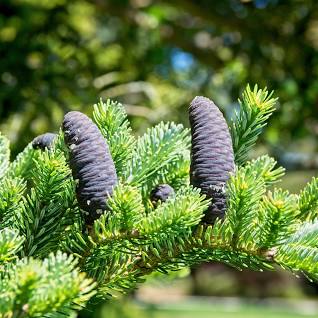
– Cones: Cylindrical, upright; vivid violet-purple when young, maturing to brown — among the most ornamental cones in the fir family
– Habit: Clear stem supporting a wide, flat-topped to gently domed spreading canopy
– Aspect: Full sun to partial shade
– Soil: Moist, well-drained; slightly acidic preferred; tolerant of most soils with good drainage
– Hardiness: Fully hardy — native to the subalpine forests of Japan
– Maintenance: Very low
Description
Abies veitchii in umbrella form is one of those plants that creates a moment in the garden — a piece of living architecture that stops you and holds your attention, not through colour or drama, but through a quality of presence and detail that is entirely its own. The clear stem, the wide, flat-topped canopy, and the extraordinary silver-white undersides of the needles combine to create something that reads as both carefully designed and entirely natural, which is the most difficult balance to achieve in a garden plant and the most rewarding when it is found.
The silver is the thing. On a still day the canopy is a rich, glossy dark green. On a breezy day, as the branches lift and turn, the silvery undersides flash and shimmer in a way that catches the light from across the garden and changes the quality of the whole space. The violet-purple cones of late spring and early summer add a further layer of colour that sits unexpectedly and beautifully against the silver-green above.
A specimen of genuine rarity and distinction — one that will define the space it occupies for decades.
Caragh Garden Notebook
Planting:
Plant in autumn or early spring into moist, well-drained soil — the Abies family requires good drainage above all else and will not perform in waterlogged or poorly drained conditions. A slightly acidic soil is preferred but the plant is tolerant of most reasonable garden soils. Choose the position with real intention — this is a specimen plant that deserves a prominent, considered spot where both the architectural umbrella form and the silver needle flash can be properly seen and appreciated from the house or garden. Full sun gives the densest canopy and the most vivid silver; partial shade is tolerated. Stake the stem at planting if needed to ensure it remains upright while roots establish, and mulch generously around the base.
Watering:
Water thoroughly at planting and consistently through the first two growing seasons while the root system establishes. Once settled, Abies veitchii is self-sufficient in an Irish or UK garden and requires very little supplementary watering — natural rainfall is usually more than adequate. In an exceptional or extended drought, a thorough watering will support the plant and maintain the freshness and lustre of the foliage. In containers, water regularly through the growing season and ensure drainage is always free.
Feeding:
A balanced slow-release fertiliser applied in spring for the first few years supports establishment and encourages a dense, healthy canopy. Once established, an annual spring mulch of composted bark around the base is usually sufficient — it feeds gently, retains moisture, and suppresses competition without the need for additional fertiliser in most garden soils. Avoid high-nitrogen feeds, which produce soft growth at the expense of the dense, compact canopy that makes the umbrella form so visually effective.
Pruning & Maintenance of Form:
The umbrella form is maintained by occasional light clipping of the canopy — once or at most twice per year — to preserve the clean, flat-topped or domed silhouette that gives the plant its architectural quality. Clip in late spring after any new growth has extended, and again lightly in late summer if required. Use sharp, clean shears and work from the outside of the canopy inward, preserving the overall shape rather than cutting hard into old wood. Remove any shoots that develop on the clear stem immediately — these should be taken out cleanly as soon as they appear to maintain the integrity of the standard form.
Pests & Problems:
Generally very trouble-free. Adelgids can occasionally appear — small woolly insects on the undersides of branches — and are managed with a suitable spray if they cause concern. Waterlogged or poorly drained soils are the most common cause of poor performance in any Abies; good drainage at planting is the most important preventative measure. The umbrella form should have its stem checked annually — ensure no shoots are developing on the clear stem portion and that the graft union, where the umbrella head meets the rootstock, remains clean and undamaged.
Design Notes:
The umbrella form of Abies veitchii does something very specific and does it exceptionally well — it brings the presence, the silver shimmer, and the ornamental cone colour of a magnificent fir into a scale and form that works as a garden specimen rather than a forest tree. The flat-topped canopy creates a horizontal line that provides architectural grounding in a planting scheme, anchoring softer, more seasonal plants around its base. Use it as a stand-alone specimen in a prominent lawn or gravel garden where the canopy silhouette can be seen against the sky; pair it with the Nordmann Fir standard for a conifer pairing of contrasting form — the tall pyramid and the wide umbrella — that together create a formal, considered planting of real distinction. Underplant with low-growing shade-tolerant companions — epimediums, Blechnum spicant, or a carpet of Carex — that will not compete with the canopy above but will frame the stem and root zone beautifully. For contemporary and Japanese-influenced garden schemes, the umbrella form has a quality of stillness and intention that is particularly at home — a plant that looks as though it has always been exactly where it is.
Additional information
| Pot Size |
|---|
Related products
-

Quercus castaneifolia
€2,200.00 Select options This product has multiple variants. The options may be chosen on the product page -

Prunus cerasifera ‘Pissardii’
Price range: €150.00 through €450.00 Select options This product has multiple variants. The options may be chosen on the product page -

Tilia cordata Multistem Specimen
€2,200.00 Select options This product has multiple variants. The options may be chosen on the product page -

Fagus sylvatica ‘Dawyck Gold’ Specimen
€950.00 Select options This product has multiple variants. The options may be chosen on the product page