

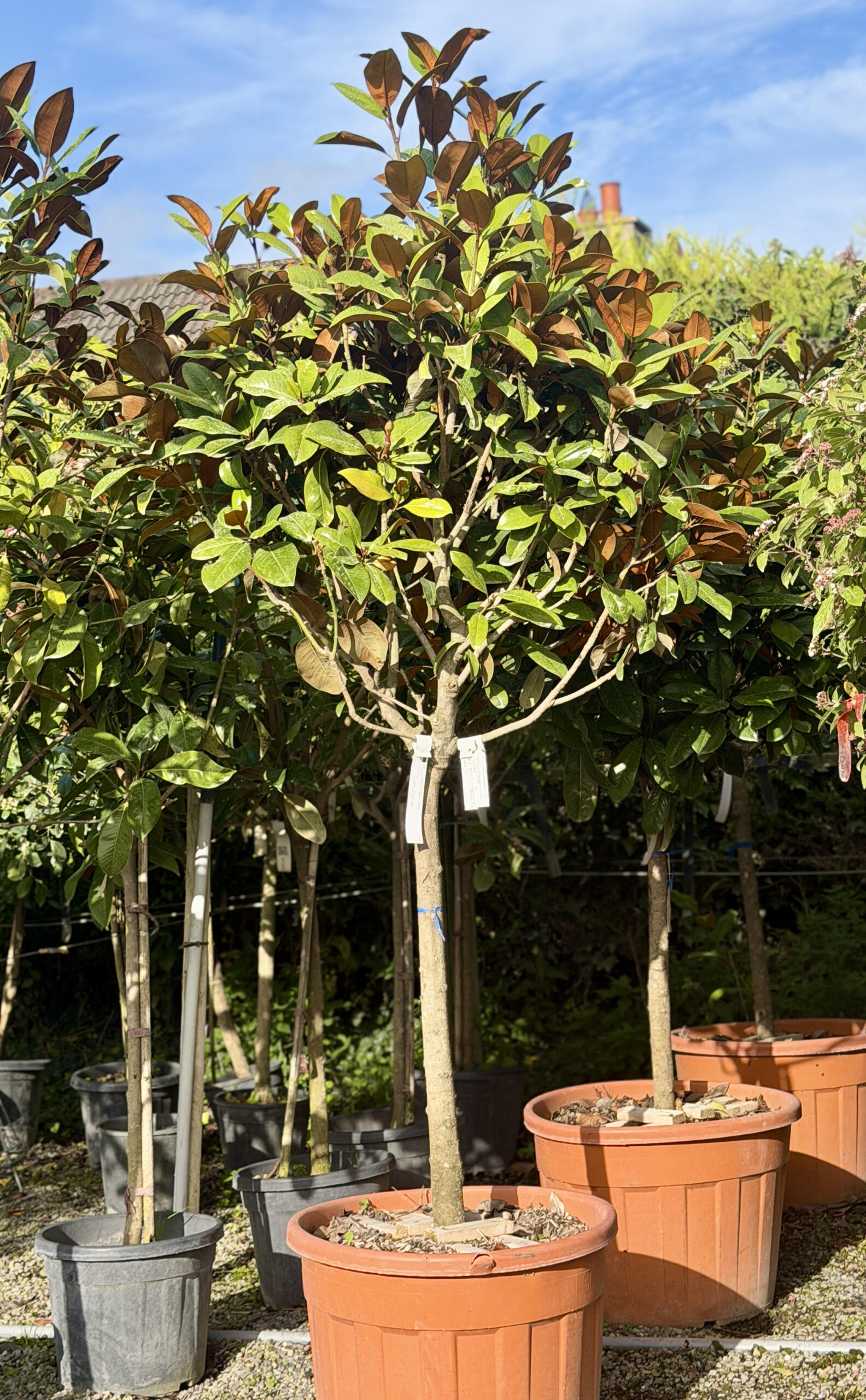
Magnolia grandiflora ‘Ferruginea’ 1/2 Standard
€400.00
Description
Quick Facts
– Botanical Name: Magnolia grandiflora ‘Ferruginea’
– Common Name: Evergreen Magnolia ‘Ferruginea’ — Half Standard
– Plant Type: Evergreen tree, trained half standard
– Stem Height: Approx. 80–100cm clear stem
– Canopy Form: Rounded, bushy head
– Mature Height: 6m–10m (as a free-growing tree; half standard form maintained by pruning)
– Mature Spread: 4m–6m
– Flowering Period: June to September
– Flower Colour: Creamy-white, large and powerfully fragrant
– Foliage Colour: Large, glossy deep green on the upper surface; distinctive rich rusty-brown felted underside
– Hardiness: Hardy — benefits from a sheltered position in colder areas
– Soil Requirements: Moist, well-drained, fertile; slightly acidic preferred
– Aspect: Full sun to partial shade; sheltered from cold, drying winds
– Maintenance: Low — light pruning to maintain the standard form
Description
Magnolia grandiflora ‘Ferruginea’ is one of the most distinguished evergreen trees you can grow — and in this trained half standard form, it becomes something truly special. The large, bold leaves are extraordinary on both sides: deeply glossy and rich green above, and covered beneath in a dense, velvety felt of warm rusty-brown — the ferruginous colouring that gives this cultivar its name and sets it apart from all other evergreen magnolias. Through summer and into early autumn, enormous creamy-white blooms open in succession, each one powerfully fragrant and breathtakingly beautiful, held above the foliage on a neat, rounded head.
Grown on a clear stem as a half standard, ‘Ferruginea’ brings all the drama and presence of this magnificent tree into a more considered, sculptural form — equally at home in a generous container, a sheltered courtyard, or as a refined focal point in a well-planted border. This is a plant that commands attention in every season, and earns it completely.
Caragh Garden Notebook
Planting:
Plant in spring in moist, well-drained, fertile soil — slightly acidic conditions will give the best results. Choose a sheltered position in full sun or partial shade, protected from cold drying winds which can scorch the large evergreen leaves. In colder or more exposed gardens, a south or west-facing wall provides the ideal microclimate and brings out the best in both the foliage and the flowering. If planting in a container, use a large, generous pot with a loam-based ericaceous compost and ensure excellent drainage.
Watering:
Water thoroughly after planting and consistently through the first two to three growing seasons while the tree establishes. Magnolia grandiflora appreciates reliable moisture, particularly during dry summers — do not allow the root zone to dry out for extended periods. In containers, water regularly and check frequently during warm weather, as large evergreen plants in pots can dry out quickly in summer.
Feeding:
Apply a balanced, slow-release fertiliser or a mulch of well-rotted compost in early spring. For container-grown specimens, feed with a liquid fertiliser every two to three weeks through the growing season to support the large, glossy foliage and encourage generous flowering. An ericaceous feed will help maintain the slightly acidic conditions that suit this cultivar best.
Seasonal Care & Tidy-Up:
Prune lightly in spring to maintain the rounded shape of the standard head, removing any crossing, dead, or outward-growing branches. Magnolias do not respond well to hard pruning, so little and often is always the right approach. Remove any shoots that appear on the clear stem below the head promptly to preserve the standard form. Protect young plants in their first winter with a fleece or sheltered positioning if hard frosts are forecast.
Pests & Problems:
Generally healthy and trouble-free once established. Scale insects can occasionally appear on the stems — treat with a suitable winter wash if needed. Leaf scorch on the margins can occur in exposed positions or during cold, drying winds; a sheltered aspect largely prevents this. Yellowing foliage may indicate soil that is too alkaline — address with ericaceous compost and feed.
Design Notes:
The half standard form makes ‘Ferruginea’ one of the most versatile and elegant of all evergreen statement plants. The clear stem and rounded head give it a refined, sculptural quality that suits formal gardens, contemporary courtyard settings, and sheltered terraces equally well. In a large container, a pair flanking a doorway or gateway creates an effect of quiet, enduring grandeur. The rusty-brown leaf undersides are a year-round talking point — plant where the undersides of the lower leaves can be seen and appreciated, particularly in a breeze. In summer, when the great white blooms open and the fragrance carries on warm air, there are few more beautiful plants in the garden.
Propagation:
Semi-hardwood cuttings can be taken in late summer, though results are variable. For named cultivars in trained standard form, sourcing prepared nursery-grown specimens is always recommended to preserve the cultivar’s characteristics and the quality of the standard framework.
Additional information
| Pot Size |
|---|
Related products
-

Ilex Nellie Stevens – 1/2 Standards
Price range: €235.00 through €620.00 Select options This product has multiple variants. The options may be chosen on the product page -
Euonymus jap. Elegant Aureus Half Standard
€125.00 Select options This product has multiple variants. The options may be chosen on the product page -
Euonymus japonicus 1/2 Standard
€180.00 Select options This product has multiple variants. The options may be chosen on the product page -

Olea europaea / Olive Tree – 60-80cm Girth
€650.00 Select options This product has multiple variants. The options may be chosen on the product page