
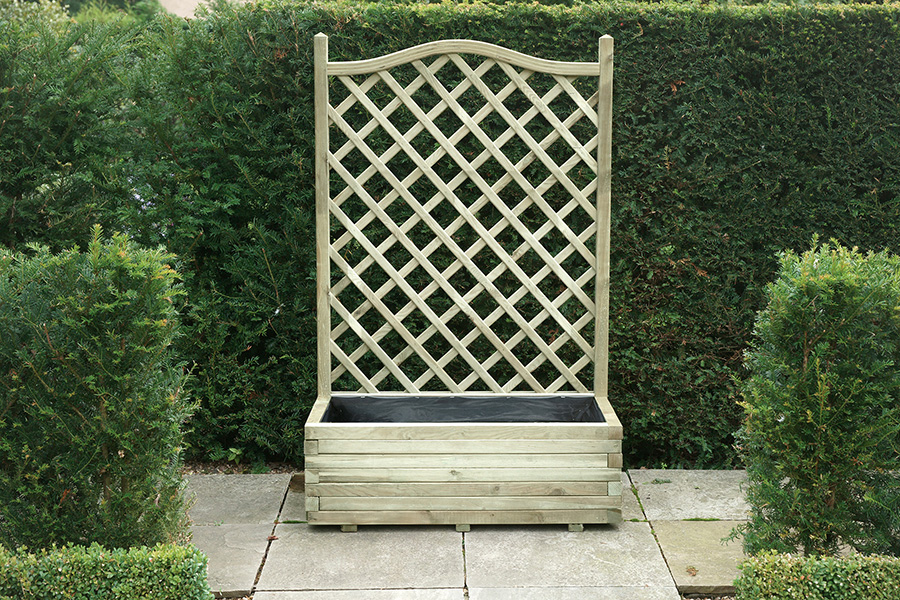
Planter & Trellis
€180.00
3 in stock
Frequently Bought Together

Description
Quick Facts
Product Name: Planter & Trellis
Product Dimensions: 153cm H x 50cm D x 100cm W
Material: Pressure-treated timber, pre-lined.
Product Type: Planed timber planter box with diamond lattice trellis
Trellis Pattern: Diamond lattice (70mm apertures, approximate)
Finish: Natural pressure-treated timber (can be painted or stained)
Durability: Pressure-treated for long-lasting outdoor use
Assembly: May require simple assembly
Material: Pressure-treated timber, pre-lined.
Product Type: Planed timber planter box with diamond lattice trellis
Trellis Pattern: Diamond lattice (70mm apertures, approximate)
Finish: Natural pressure-treated timber (can be painted or stained)
Durability: Pressure-treated for long-lasting outdoor use
Assembly: May require simple assembly
Description
The Planter & Trellis is one of those garden pieces that does the work of two—it gives you ground-level planting in a solid timber planter, plus vertical growing space on the trellis above. It’s the kind of structure that adds instant height and interest to patios, terraces, or anywhere you want to create a green screen, soften a boundary, or add privacy without the permanence of a full fence.
The planter box is built from planed timber with a clean, substantial construction that’s designed to last outdoors year-round. It’s deep enough for proper root growth—shrubs, perennials, grasses, or even small trees—and the integrated trellis rises up behind, ready to support climbers that weave through the diamond lattice and create a living wall of foliage and flowers.
The diamond lattice pattern (typically 70mm apertures) is classic for good reason: it’s open enough to let light through and give climbers room to grow, but tight enough to offer real support and visual interest even before anything’s planted. The trellis adds height without bulk, making this ideal for smaller gardens or patios where you want screening or structure without losing too much light or space.
The pressure-treated timber weathers to a soft silver-grey if left natural, or takes paint and stain beautifully if you want it to stand out or blend into a specific colour scheme. Left unpainted, it sits quietly behind the planting. Painted white, it becomes a classic cottage garden feature. Stained dark grey or charcoal, it’s sleek and contemporary.
This is a planter for creating vertical gardens, screening utility areas, adding privacy to patios, or simply bringing height and structure to flat, open spaces. It’s functional, good-looking, and flexible enough to work in just about any garden style.
Caragh Garden Notebook
Installation & Preparation
Positioning:
- Choose a level, stable surface—paving, decking, gravel, or compacted soil
- Ensure the location suits the plants you’re planning to grow (sun/shade requirements)
- Consider the trellis orientation—position it to screen a view, create privacy, or provide support for climbers in the right direction
- For stability, especially with taller trellis sections, position against a wall or fence, or secure to the ground if freestanding
Securing Freestanding Units:
- If using as a freestanding screen (not against a wall), consider securing the base to the ground for stability
- Use L-brackets or metal stakes to fix the planter to paving or decking
- For units on soil or gravel, drive stakes into the ground and fix to the planter frame
- This is particularly important in exposed or windy sites, or when climbers are mature and catching the wind
Drainage:
- Check that drainage holes are present in the planter base (if not, drill 3–5 holes, 15–20mm diameter, evenly spaced)
- Raise the planter slightly off the ground using pot feet, bricks, or timber offcuts to allow water to drain freely
- Poor drainage leads to waterlogged soil and root rot
Lining (Optional but Recommended):
- Line the inside of the planter with heavy-duty plastic sheeting or pond liner to protect the timber from constant moisture
- Cut the liner to size, leaving excess at the top to fold over the rim
- Pierce drainage holes in the liner to match the holes in the planter base
- Lining extends the life of the planter significantly
Filling:
- Add a 5–10cm layer of drainage material (gravel, broken terracotta, or crocks) to the base
- Fill with good-quality multi-purpose or peat-free compost, or a mix of compost and topsoil for larger plantings
- For shrubs and climbers, use a loam-based compost (e.g., John Innes No. 3) for stability and long-term nutrition
- Leave a 3–5cm gap between the compost surface and the top of the planter for watering
Planting Ideas
Planter Box (Ground Level):
- Shrubs: Box (Buxus), lavender, rosemary, small roses, hydrangeas—provide structure and year-round interest
- Perennials: Hostas, hardy geraniums, heucheras, sedums—seasonal colour and foliage interest
- Grasses: Miscanthus, Stipa, Carex—add movement and texture
- Seasonal displays: Spring bulbs, summer bedding, autumn grasses, winter evergreens
- Edibles: Herbs (rosemary, thyme, sage), compact vegetables, salad leaves
Trellis (Vertical Planting):
- Climbing Roses: Compact varieties like ‘New Dawn’, ‘Compassion’, or ‘Gertrude Jekyll’—flowers and fragrance
- Clematis: ‘Jackmanii’, ‘Nelly Moser’, ‘Henryi’—weaves beautifully through lattice, prefers roots shaded (perfect with planter below)
- Honeysuckle (Lonicera): ‘Serotina’, ‘Graham Thomas’—fast-growing, fragrant, excellent coverage
- Jasmine: Star jasmine (evergreen, scented) or common jasmine (deciduous, summer scent)
- Annual Climbers: Sweet peas, morning glory, black-eyed Susan—seasonal colour, easy to change year to year
- Evergreen Climbers: Ivy (for year-round coverage), star jasmine (scented, evergreen in mild areas)
Planting Combinations:
- Classic pairing: Plant a shrub or perennials in the planter box, train a climbing rose or clematis up the trellis
- Scented screen: Lavender or rosemary in the planter, honeysuckle or jasmine on the trellis for fragrance at multiple heights
- Year-round interest: Evergreen shrub (box, rosemary) in the planter, evergreen climber (ivy, star jasmine) on the trellis
- Seasonal colour: Change bedding plants in the planter seasonally, grow annual climbers on the trellis for summer colour
Maintenance
Initial Treatment:
- Units arrive pressure-treated and ready to use
- For enhanced protection, allow timber to weather for 6–12 months before painting or staining
- If lining the planter, install the liner before treating the exterior
- Clean with a stiff brush; apply exterior-grade timber preservative, decking oil, or wood stain
- Pay particular attention to the planter interior if not lining, and the trellis sections (more exposed surface area)
Watering:
- Container plants dry out faster than plants in the ground—check moisture levels regularly, especially in summer
- Water thoroughly until water runs out of the drainage holes
- In hot weather, may need daily watering
- Reduce watering in winter, but don’t let compost dry out completely
Feeding:
- Apply a slow-release fertiliser in spring
- Supplement with liquid feed every 2–4 weeks during the growing season for flowering plants and climbers
- Use appropriate feed for your plants (rose feed for roses, general-purpose for mixed planting)
Annual Maintenance:
- Spring: Top-dress the planter by removing the top 5cm of compost and replacing with fresh compost mixed with slow-release fertiliser
- Treatment: Apply a fresh coat of preservative, oil, or stain to the exterior annually
- Cleaning: Remove debris, moss, or algae from timber surfaces and trellis lattice
- Drainage check: Ensure drainage holes remain clear
Climber Management:
- Tie in young growth with soft garden twine to guide climbers onto the trellis
- Prune climbers according to type (roses, clematis, honeysuckle all have different pruning needs)
- Trim back vigorous growth to prevent climbers overwhelming the trellis or becoming too heavy
- Check ties regularly; replace any cutting into stems
Longevity:
With proper installation (drainage, lining) and annual treatment, expect 10–15 years of service.
Design Ideas
Patio Privacy Screens:
Use planter & trellis units to create privacy around seating areas, hot tubs, or dining spaces. Position 2–3 units in a row for a living screen that feels softer and more natural than solid fencing. Plant with climbers for seasonal coverage.
Boundary Softening:
Place units along boundaries (walls, fences, or edges of paved areas) to soften hard lines and add vertical planting. The trellis extends the planting height without the weight of a full fence or wall.
Garden Zoning:
Use as freestanding dividers to create “rooms” within the garden—separate dining areas from play spaces, screen utility areas (bins, compost), or divide formal and informal sections. The planter & trellis creates a boundary that feels intentional but not divisive.
Balcony & Terrace Planting:
Ideal for balconies, roof terraces, or small patios where ground space is limited but you want vertical planting and screening. The integrated design means you get maximum planting in a compact footprint.
Framing Views:
Position units on either side of a doorway, gate, or pathway to frame the entrance and add height. Plant with matching climbers for symmetry, or different varieties for a more informal look.
Backdrop for Seating:
Place behind a bench or seating area to create a green backdrop and add a sense of enclosure. Plant with scented climbers (honeysuckle, jasmine, roses) for fragrance at head height.
Screening Utilities:
Hide bins, air conditioning units, or other eyesores with planter & trellis units. Plant with fast-growing climbers (honeysuckle, annual climbers) for quick coverage.
Vertical Vegetable Gardens:
Grow climbing vegetables (beans, peas, cucumbers, squash) on the trellis, with herbs or salad leaves in the planter below. Perfect for small gardens or patios where ground space is limited.
Colour & Finish:
- Natural timber: Weathers to silver-grey; blends into the garden, lets planting take centre stage
- White or pale grey: Classic cottage garden look, crisp and clean, works beautifully with pastel flowers
- Dark stain (charcoal, black, deep brown): Modern, dramatic, makes greenery and flowers pop
- Soft green or blue-grey: Sits quietly in the garden, complements planting without competing
- Two-tone finish: Paint the planter one colour and the trellis another for visual interest (e.g., dark planter, light trellis)
Grouping & Arrangement:
- Single unit: Focal point or accent piece
- Pair: Flanking a doorway, gate, or pathway for symmetry
- Row of 3+: Create a living screen or boundary
- Staggered arrangement: Vary spacing for a more informal, naturalistic feel
Related products
-
Lucia Stone Grey Planters
Price range: €130.00 through €420.00 Select options This product has multiple variants. The options may be chosen on the product page -
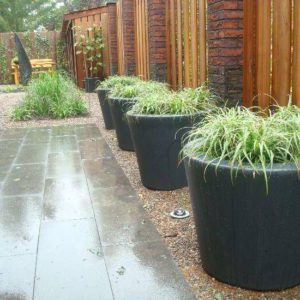
Acer Fibreglass Planter
Price range: €280.00 through €830.00 Select options This product has multiple variants. The options may be chosen on the product page -
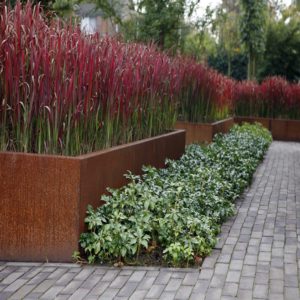
Corten Steel Andes Trough
Price range: €405.00 through €985.00 Select options This product has multiple variants. The options may be chosen on the product page -
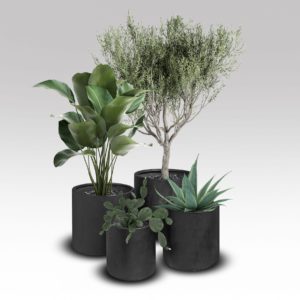
Naxos Contemporary Stone Grey Pots
Price range: €380.00 through €535.00 Select options This product has multiple variants. The options may be chosen on the product page